

Loading cart...
 My Account
 Track Order
 Sports Guide
A silver end cap, a missing "Japan", a 9-digit code and a Mavis sticker without "Made in Japan". Four things badminton WhatsApp groups are calling counterfeit. Every one of them is a manufacturer change. Two are confirmed in writing by Sunrise Sports India, and we show you the letters.
Last updated: 23 August 2026. Written by Aashish Rrastogi, who has been retailing Yonex badminton equipment in India since 2012 and founded SportsUncle in 2016. The dealer notices reproduced below were issued to the trade.
Short answer: If your new Yonex racket has a silver end cap with no "Japan" text, or a 9-character code instead of the old 8-character one ending in SP or JP, the racket is not fake. Sunrise Sports India has confirmed the January 2026 end cap change in writing. The country code change is separate and came from Yonex globally in 2025.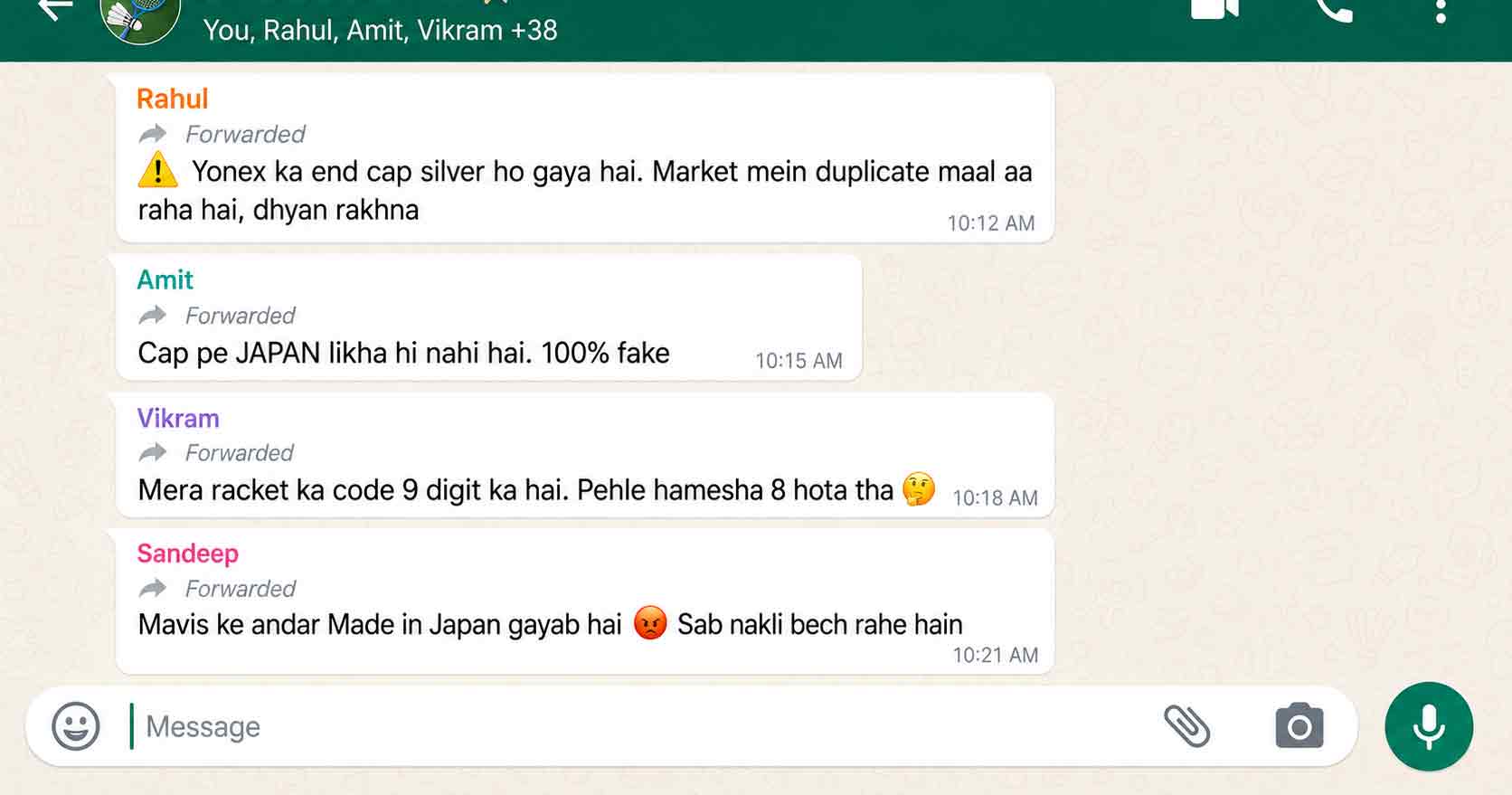
What the WhatsApp message is claiming
Since around May this year, the same set of messages has been going around badminton groups in India. The wording varies but the claims are consistent:
- Yonex end caps have changed colour, so the new ones are counterfeit
- "Japan" has been wiped off the end cap, which means the racket is no longer a real Yonex
- The racket code has extra digits and no country letters, so it is a grey import
- "Made in Japan" has vanished from the sticker inside Mavis shuttles, so the shuttles are duplicates
We have had these forwarded to us by customers roughly a dozen times. Every one of the four claims points at something that genuinely changed. None of them means what the forward says it means.
We are a Yonex retailer, so we have an obvious interest in you not believing this. Which is exactly why the rest of this article leans on the importer's own letters rather than on our word.
Did Yonex really change the badminton racket end cap?
Yes. The change took effect from January 2026. The white end cap was replaced with a silver-based finish across Japan, Taiwan and China production. On Japan-made rackets, the word "Japan" was removed from the cap at the same time.
Sunrise Sports (India) Pvt Ltd, the authorised Yonex importer for India, issued a letter to its dealers dated 5 May 2026 setting this out, signed by Karan Dhar, Director.
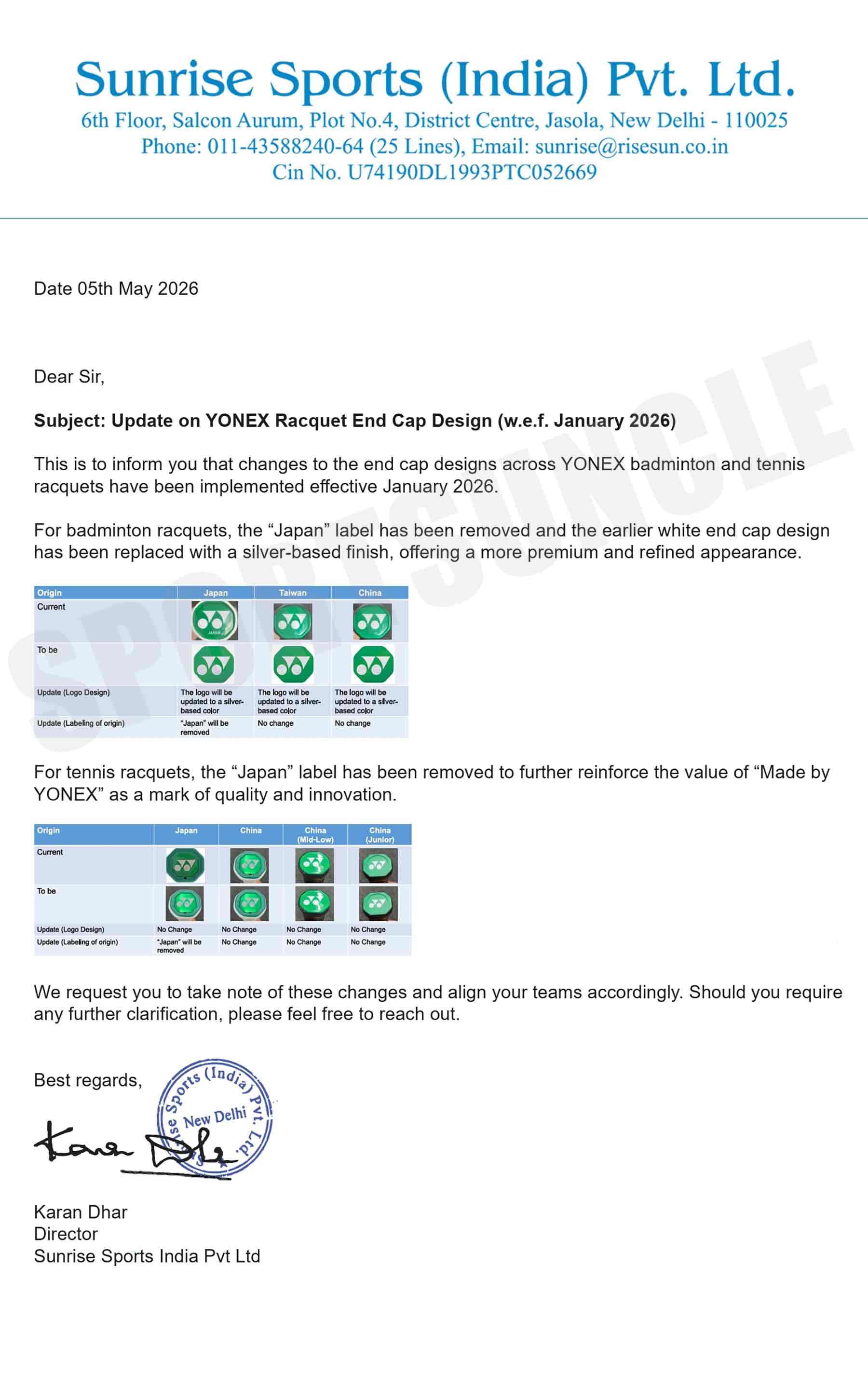
The letter includes a comparison table. Here is what it says, broken out by origin:
| Origin | Logo colour | "Japan" wording |
|---|---|---|
| Japan | Updated to silver-based colour | Removed |
| Taiwan | Updated to silver-based colour | No change (never carried it) |
| China | Updated to silver-based colour | No change (never carried it) |
This is why the rumour gets traction. A player who owns a 2023 Japan-made racket and buys a 2026 one sees two visibly different caps sitting next to each other. Both are genuine.
The same letter covers tennis racquets separately. There the logo design did not change at all, and only the "Japan" wording was removed from Japan-origin frames.
Why did Yonex remove "Japan" from the end cap?
To push "Made by Yonex" as the quality mark instead of the country of manufacture. Sunrise's letter states the removal is meant to reinforce the value of "Made by YONEX" as a mark of quality and innovation.
There is a commercial reason behind this that Yonex has been fairly open about. Over the years, a belief spread among buyers that Japan-made rackets were superior and that China or Taiwan production was second-rate. Yonex has consistently said the specifications, materials and production standards are identical regardless of which plant builds the frame. Taking the country name off the cap removes the thing people were sorting on.
You can argue about whether that is the right call. Plenty of long-time players liked knowing where their frame came from, and we have heard that complaint from customers. But it is a branding decision by the manufacturer, not a sign of anything going wrong with the product.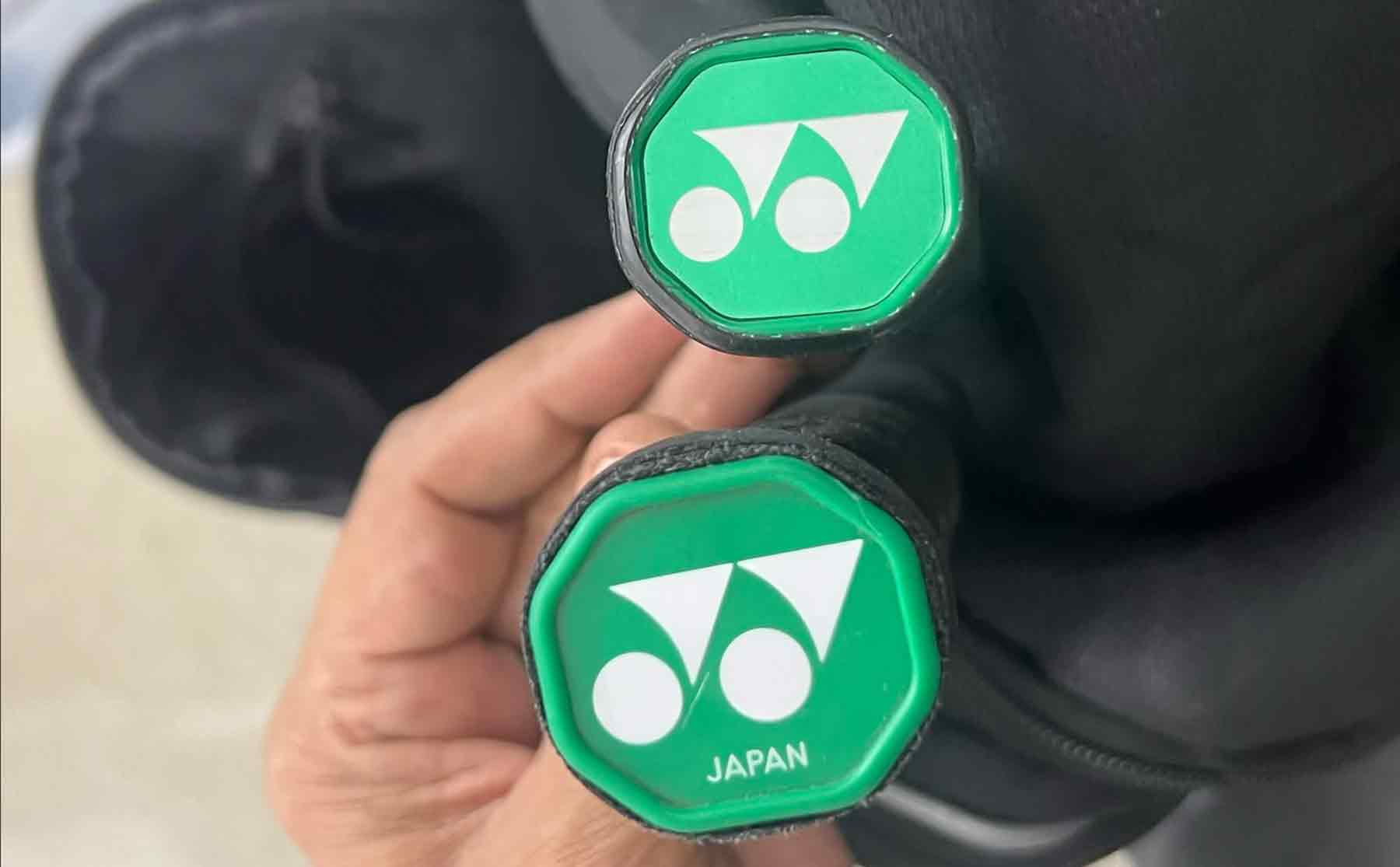
My Yonex racket has a 9-digit code. Is it fake?
No. A longer code without a two-letter country suffix indicates newer production, not a counterfeit. Yonex has phased out the old letter country code system and replaced it with numeric codes used internally for batch and production-line traceability.
This is the question we get most often, and it deserves a proper answer because the people asking it are usually experienced players who know the old system well.
One thing to be upfront about before we go further. The two Sunrise letters reproduced on this page cover the end cap and the Mavis label. Neither of them deals with the racket code. What follows comes from Yonex specialist retailers in Europe who reported the change during 2025, saying the instruction came from Yonex Japan. We have not seen an India-specific notice on it, and we will say so rather than dress it up as something it is not. What we can vouch for directly is what we see in our own stock, which is that codes on newer arrivals no longer carry the two-letter suffix.
What the old code looked like
The cone code on older Yonex rackets was 8 characters and ended in two letters. Players decoded it as DDMMYXCC:
- DD, day of production
- MM, month
- Y, last digit of the year
- X, revision number
- CC, two-letter country code such as JP, SP, CN, IN or TW
Worth clarifying: Yonex never officially published this format. It is a convention the badminton community worked out over the years, and it was accurate enough to be useful. It was never a company specification.
What the new code looks like
A customer recently sent us the code 10100152C and asked whether the DD/MM/YY reading made it old stock. It is a fair question, and here is the honest answer.
That code is 9 characters and ends in a single letter. The old format was 8 characters ending in two letters. It does not fit the old structure at all, which is the tell. It belongs to the new numeric system.
We are not going to decode a manufacturing date out of it. Yonex has not published how the new codes are built, and guessing at a date and getting it wrong would be worse than saying we do not know. Origin and production details for a specific frame can still be traced, but only by Sunrise Sports India through their internal system. That request has to go to them, not to a retailer.
Two different things people are mixing up
The cone code and the end cap are separate. It helps to keep them apart:
| Before | Now | |
|---|---|---|
| End cap (logo plate) | White finish, "Japan" printed on Japan-made frames | Silver-based finish, no "Japan" wording |
| Cone code | 8 characters ending in JP, SP, CN, IN, TW | Numeric code, no country letters, internal use |
The rollout is gradual. Old-code and new-code rackets are both sitting in the Indian market right now, and will be for a while. Two genuine rackets bought three months apart can look completely different on both counts.
Does an older production date mean the racket is fake?
No. Even under the old code, the date told you when the frame was built and nothing more. Rackets legitimately sit in the supply chain for months between production, import, distribution and sale. An older date has never been an authenticity test.
It is reasonable to care about age if you are paying full price for a discontinued model. That is a value question, not a genuineness question, and you should ask us about it directly rather than reading it out of a code.
Has "Made in Japan" been removed from Mavis shuttlecocks?
Yes, from the inner label of MAVIS nylon shuttlecocks, effective June 2026. Sunrise Sports India confirmed this in a dealer letter dated 17 June 2026. The letter states plainly that this is a design change only and does not affect product specifications, quality or performance in any way.
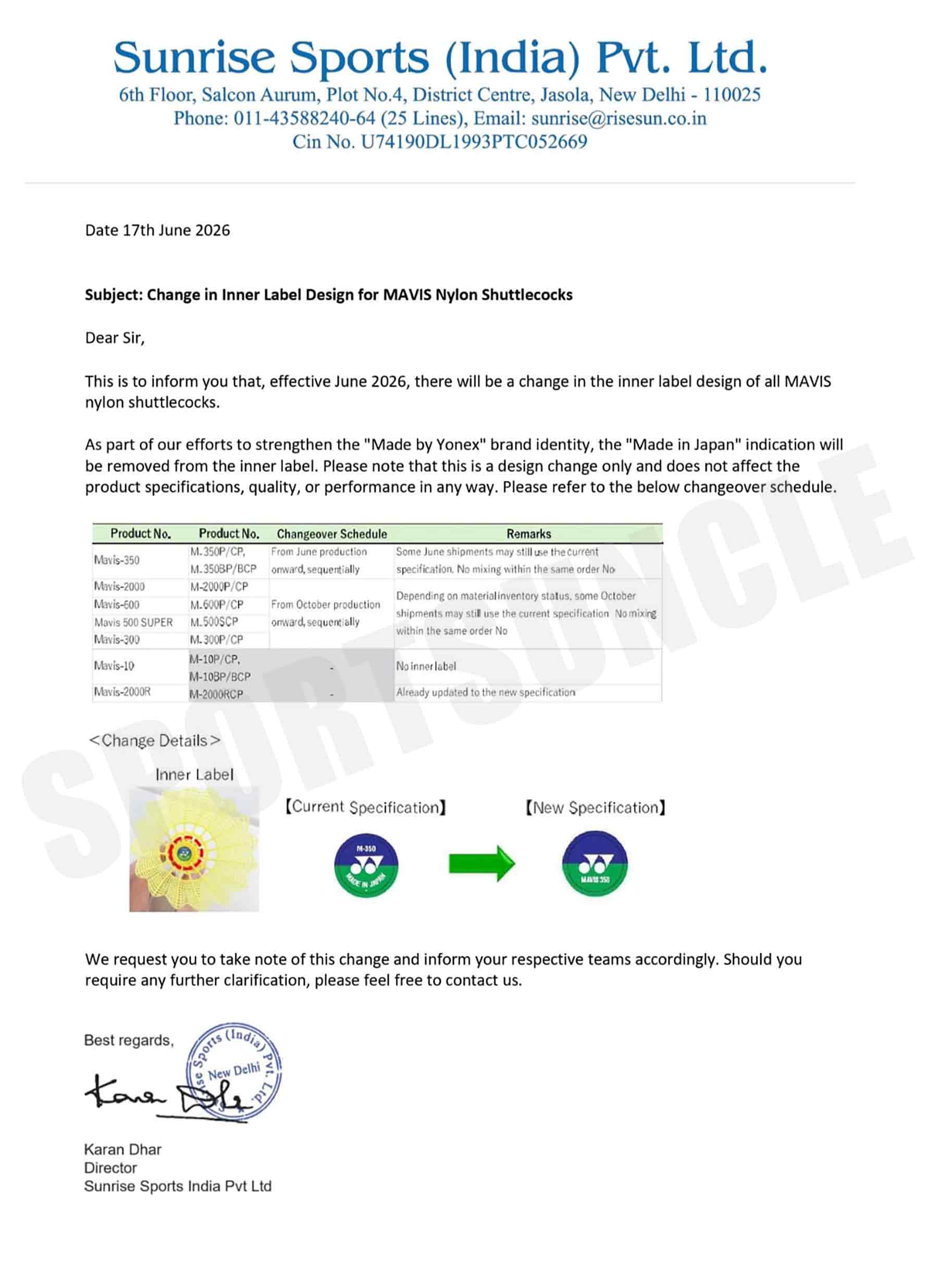
The old inner label showed the model number with "MADE IN JAPAN" curved around the ring. The new one shows the YY logo with the model name, for example MAVIS 350.
Changeover schedule by model
| Model | Product code | Changeover |
|---|---|---|
| Mavis 350 | M.350P/CP, M.350BP/BCP | From June 2026 production onward, sequentially |
| Mavis 2000 | M.2000P/CP | From October 2026 production onward, sequentially |
| Mavis 600 | M.600P/CP | From October 2026 production onward, sequentially |
| Mavis 500 Super | M.500SCP | From October 2026 production onward, sequentially |
| Mavis 300 | M.300P/CP | From October 2026 production onward, sequentially |
| Mavis 10 | M-10P/CP, M-10BP/BCP | Not applicable; this model has no inner label |
| Mavis 2000R | M-2000RCP | Already on the new specification |
Two details from the letter matter for buyers:
- Some June shipments of Mavis 350 and some October shipments of the other models may still carry the current specification, depending on material inventory. Both labels are correct during the overlap.
- There is no mixing within the same order number. A single tube or box will be consistent.
If you are holding a Mavis 10 and the inner sticker seems to be missing, nothing is wrong. That model never had one.
What about feather shuttles like AS-30 and AS-40?
We do not have documentation covering feather shuttles, so we are not going to claim anything about them. The 17 June letter is specific to MAVIS nylon shuttlecocks.
Feather shuttle production genuinely varies by model and by market, and the country of origin on the tube reflects where that batch was made. If you have seen a forward claiming the AS series inner sticker changed, treat it as unverified for now. We have asked Sunrise for clarification and will update this article when we have a written answer.
So how do you actually check whether a Yonex is genuine in India?
None of the four things in the WhatsApp forward is a useful test. Here is what is:
- Buy from a genuine retailer and keep your invoice. This is the only check that works before the racket is in your hands. SportsUncle has supplied Yonex since 2016 to weekend club players and state-level competitors alike, and every order generates a GST invoice in your name under your account. Keep it. If a question ever comes up about a product, that invoice is what establishes where it came from.
- Check the price against MRP. A racket that lists at ₹10,000 is not being sold at ₹2,500 by anybody legitimate. Steep discounts on current-season models are the most reliable counterfeit signal there is.
- Feel the serial number. On genuine frames the code is laser-engraved into the cone. Run a fingernail across it and you should feel the indentation. Printed or stickered codes are a problem.
- Test the hologram. Genuine Yonex hologram stickers use a strong adhesive and resist peeling. Counterfeit ones lift with a fingernail. Note that the Sunrise scratch-code hologram was discontinued for the Indian market some years ago, so its absence on newer stock is not by itself a red flag.
- Look at the logo quality. The YY mark and the YONEX wordmark should be crisp and correctly proportioned. On counterfeits the letter O is often too wide and round.
These five checks are Yonex-specific. The broader signs that apply to counterfeit sports equipment across brands are worth knowing too, since the same sellers rarely stop at one brand.
One thing worth saying plainly: Yonex does not run a public serial number checker. There is no website where you type in your cone code and get a genuine or fake verdict. Any site claiming to offer one is not connected to Yonex. If someone tells you your racket failed an online check, ask them which official system they used.
What to do if you still think your racket is counterfeit
- Do not remove the factory grip before raising it, since the barcode underneath is part of the check
- Keep the invoice, the packaging and the cover
- Photograph the cone code, the end cap and the shaft printing in good light
- Raise it with Sunrise Sports
If you have gone through everything above and still believe the product is counterfeit, take it to the importer rather than to a retailer or a WhatsApp group. Sunrise Sports (India) Pvt Ltd is the only party in India able to verify a Yonex product against Yonex records, and they are the correct authority for a counterfeit report:
- Sunrise Sports (India) Pvt Ltd, 6th Floor, Salcon Aurum, Plot No. 4, District Centre, Jasola, New Delhi 110025
- Email: customercare@risesun.co.in
Have your invoice and your photographs ready before you write to them. A report with the seller name, purchase date and clear images gets dealt with. One without them usually does not.
Anything to do with an order placed on SportsUncle, such as a damage claim or a replacement, should come through our normal customer support channel with your order number, as always.
Frequently asked questions
Is a silver Yonex end cap fake?
No. Yonex changed the badminton racket end cap from a white finish to a silver-based finish effective January 2026. Sunrise Sports India confirmed this to dealers in a letter dated 5 May 2026.
Why is "Japan" missing from my Yonex end cap?
Yonex removed the "Japan" wording from Japan-origin end caps in January 2026 to emphasise "Made by Yonex" over country of manufacture. Taiwan and China caps never carried the wording.
What does a 9-digit Yonex racket code mean?
It means the racket was produced under Yonex's new numeric coding system, which replaced the old 8-character code ending in a two-letter country suffix. The new codes are for internal batch traceability and are not publicly decodable.
How do I read the date on a Yonex racket code?
On older rackets the community read the 8-character cone code as DDMMYXCC, giving day, month, year, revision and country. This was never officially published by Yonex, and it does not apply to the new numeric codes.
Do JP, SP, CN and IN codes mean different quality?
No. Those letters indicated the market a racket was intended for, not a quality tier. Yonex has said specifications, materials and production standards are identical across plants, and retired the letter codes partly because of this misconception.
Are Mavis shuttles without "Made in Japan" fake?
No. Yonex removed the "Made in Japan" text from the inner label of Mavis nylon shuttlecocks from June 2026. Sunrise Sports India confirmed in writing that it is a design change only, with no effect on specification, quality or performance.
Which Mavis models are affected and when?
Mavis 350 from June 2026 production onward. Mavis 2000, 600, 500 Super and 300 from October 2026 production onward. Mavis 10 has no inner label. Mavis 2000R is already on the new label.
Can I check my Yonex serial number online?
No. Yonex does not operate a public serial number verification website. The cone code is an internal production code. Only Sunrise Sports India can trace a specific frame, and that request should go to them directly.
Does an old production date mean my racket is fake?
No. The date only shows when the frame was manufactured. Stock legitimately moves through import and distribution over several months.
Where should I buy genuine Yonex products in India?
From a retailer sourcing through Sunrise Sports (India) Pvt Ltd, the authorised Yonex importer, who issues a GST invoice. You can browse our full Yonex range or the wider badminton rackets category.
Where this leaves you
All four things people are panicking about are real changes, and none was made by a counterfeiter. The end cap and the Mavis label are documented in writing by the importer, and both letters are reproduced above. The code change is a separate Yonex decision taken globally, on which we have not seen an India-specific notice.
The genuinely useful checks have not changed: buy from a genuine retailer, keep the invoice, be suspicious of prices that are too good. Everything else is cosmetic.
Before forwarding the next warning that lands in your club group, check the date on it against the letters above. Most of these messages are describing January and June 2026 production changes that the importer announced to its dealers months ago.
Leave a Reply
Your email address cannot be published. Required fields are marked*
Latest Articles from Blog
No comments