

Loading cart...
 My Account
 Track Order
 Sports Guide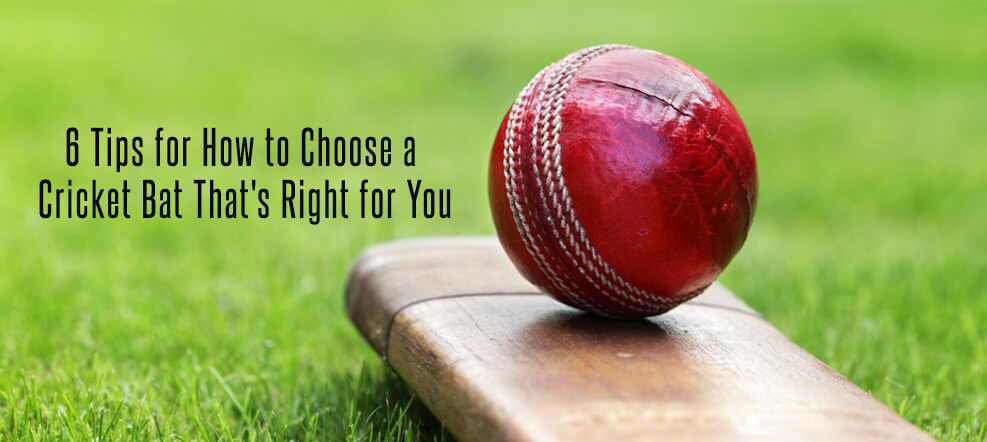
Using the right cricket bat makes all the difference in your game. Check some useful tips on how to choose a cricket bat so you can be at the top of your game.
Getting the perfect equipment won't make you a perfect player. However, arming yourself with the best and most reliable equipment can only serve to help improve your game and show off your skills in the best way possible.
Cricket is a technical game that oftentimes comes down to the players having the best equipment. But how do you go about choosing a cricket bat? With all the different brands and types out there, it can be overwhelming.
Let's go over 6 things that will help you learn how to choose a cricket bat that will work best for you.
1. Choose the Right Cricket Bat Size for You
Cricket bats come in a range of sizes. You might think that a bigger bat is better, but that’s not the case.
If you’re a smaller player, a large bat will be more difficult to handle. The key to selecting the right bat size is to match it to your height. Selecting the correct cricket bat size is crucial for optimal performance, as it ensures the bat is comfortable and easy to control. Look up a height-to-size chart online in order to find which size bat will be suited for you.
To give you an idea, people ranging from 5’3” to 5’5” usually use a size 6 bat while people over 6’ usually use a long handle (LH) size bat.
2. Ball Type
Cricket can be played with a number of different balls: leather, tennis, foam, or rubber. The type of cricket ball you use should be taken into account when purchasing a bat.
Tennis balls are lightweight. For those playing with tennis balls, you don't need a bat that's too thick or heavy since it's such a lightweight ball.
Leather and rubber balls, however, are heavier. The best cricket bat for leather ball players is sturdier and heavier. These ball types require a thicker and sturdier bat in order to exert the same force on the ball.
3. Bat Weight
Besides length, bat weight it a crucial factor that can have a huge effect on your game. Heavier bats are more durable and can make more of an impact on the ball. The increased weight, however, can be harder for some players to handle.
This can decrease your control on the bat, or make it impossible for you to swing fast enough to actually hit the ball.
Lightweight bats are easier to handle, require less strength, and can give you a faster overall bat speed. However, some find that lighter bats deteriorate more quickly and aren't as powerful.
Depending on your strengths as a player (literally and figuratively) the weight of the bat can be a huge factor in choosing a bat. Speedy, nimble, and small? A lighter bat could be for you. Strong and powerful? Perhaps a heavier bat would be better.
4. Willow Grade Differences
Different types of cricket bats are made with a different “grade” of willow. There are two main distinctions of willow: English willow and Kashmir willow. Overall, English willow is superior to Kashmir since it lasts longer, is more “springy”, and more reliable.
Bat grade refers to the classification of willow based on its appearance, grain structure, and performance potential. Skilled bat makers carefully assess and select the willow for each bat, grading it according to its particular quality and playing characteristics. Willow grading is a system that determines the quality, performance, and price of both English willow and Kashmir willow bats.
English willow bats, especially English willow cricket bats, are preferred by professional and international players due to their superior grain structure, dynamic sweet spot, and high performance. These willow bats often feature at least 6 straight grains on the face, which is considered a sign of high quality. The perfect bat is not just about looks but about the particular quality of the willow and its grain structure, which directly affects performance.
However, English willow is more expensive. Kashmir willow bats, including Kashmir willow cricket bats, are great for beginners or for those looking to get into cricket without shelling out a lot of money. Kashmir willow bats differ from English willow in terms of material properties, cost, and suitability for entry-level players. We have a wide selection of cricket bats at many different price points so you can find one that works for you and your budget.
Besides willow type, there’s also the grade to consider. The grades range from 1 to 5 with 1 being the best in terms of making, reliability, and quality. Higher bat grades have a cleaner look, more straight grains, and fewer blemishes, while lower grades may have butterfly marks, odd blemishes, or red wood. These marks are cosmetic imperfections and do not affect the bat’s playability or performance. Even lower-grade bats can offer excellent value and good playability despite these visual flaws. Grade 1 is also, understandably, the most expensive.
Learn about - Maintenance of English Willow Cricket Bat
5. Bat Based on Batting Style
Your particular batting style should also be taken into account when choosing a bat and don't forget to do machine knocking or hand knocking on the bat.
Drivers. If you hit mostly straight shots and hard drives, then a "low" bat is for you. These types of bats concentrate the "sweet spot" of the bat lower down, away from your hands.
This positioning and particular make of the bat will make it easier to hit the drives you're looking for. It won't make you a better driver, but it will make it feel amazing when you hit the ball right on that low spot.
Front foot batters. Players who tend to play mostly off their front foot do well with a bat where the "sweet spot" is right in the middle, also known as a "medium" positioning.
As the name implies, a medium bat is a mix between low and high bats. This is a great choice for general batters and batters who play off their front foot.
Hook shots/cuts. More fond of fancier shots like these? Are you more of a back-foot player? Then a "medium-high" or "high" bat is probably for you. This positioning of the "sweet spot" up towards your hands makes these hits easier and powerful.
These days Vintage and Retro series bats are more popular in youngsters due to lightweight and round bottom which is less prone to break.
6. Handle Type
And lastly, we have the type of handle. This is an understandably important part of the bat: without a proper or comfortable grip, you won't be able to control the bat how you need to. The handle should also absorb impact and shock from the ball so you don't feel it in your hands.
There are usually two types of handles: oval and round.
Oval handles are strong and provide you with great directional control of the bat. A downside is that some people find it hard to grip. Usually, the top hand ends up with most of the control with oval handle bats.
Round-handle bats make it easier to control with both the top and bottom hands. This is important for players who flick their wrists when batting. It's also easier to get a firm grip with round handles, which is essential for power hitters.
Considering Additional Factors
When choosing the perfect cricket bat, it’s essential to consider factors beyond willow type, bat weight, and size. Several additional features can significantly enhance the performance and feel of your bat in your hands.
One key aspect is the face profile of the cricket bat. Modern bats often feature a slightly rounded face, which helps distribute the impact of the cricket ball more evenly across the entire width of the bat. This design can maximise the edge profile, giving you a larger sweet spot and helping off-centre hits perform better. Some players prefer a flat face for a more traditional feel, but a slightly rounded face is favoured in the modern game for generating supreme balance and optimum stroke play.
Edge thickness and spine height are also worth considering. Bats with thicker edges and a pronounced spine offer a bigger power profile, dramatically increasing the bat’s ability to handle centre strikes and even normal impact positions. This is especially useful for players who want to maximise power without dramatically increasing weight. Look for bats that offer an extended sweet spot and a huge apex, as these features can help you get the most out of every shot.
The grip and quality of the handle can affect your comfort and control. While handle shape has been discussed, the grip material and how it feels in your hands during long innings is just as important. A good grip can help you maintain control, especially when playing with a heavier bat or during aggressive foot play.
Finally, don’t overlook the aesthetics and branding of your bat. Top cricket bat brands like Kookaburra cricket bats, SS cricket bats, GM cricket bats, and Gray Nicolls have built reputations for quality and innovation over a century. While the look of your bat won’t affect your performance directly, feeling confident with a bat you like can make all the difference on the field.
By considering these additional factors—face profile, edge and spine design, grip quality, and even the bat’s appearance—you’ll be better equipped to choose a cricket bat that truly matches your playing style and helps you perform at your best.
How to Choose a Cricket Bat: Wrapping Up
What seems like a simple task can turn into an overwhelming mess. And while there are many factors to consider, all of them can have a huge effect on your game.
Hopefully, this list outlines the key factors to consider when choosing a bat in a way that's easy to understand. If you have any other questions or need more help learning how to choose a cricket bat or maintenance of a cricket bat, or which cricket exercises are good for you then don't hesitate to contact us.

Viswanath M
Meet the maestro behind the cricketing quill – a wordsmith whose ink flows with the rhythm of a perfectly timed cover drive. When the cricket ball rests, my pen takes the spotlight, transforming every match, every player, into a poetic symphony of leather against willow. With a laptop as my crease and words as my bouncers, I bowl over readers with stories that swing and spin.
Related Products
-30%
₹995 ₹695
-52%

₹125,000 ₹60,000
-28%
₹6,400 ₹4,580
-30%
₹27,000 ₹18,900
Comments: 2
Great helpful article
nice content
Leave a Reply
Your email address cannot be published. Required fields are marked*
Latest Articles from Blog