

Loading cart...
 My Account
 Track Order
 Sports Guide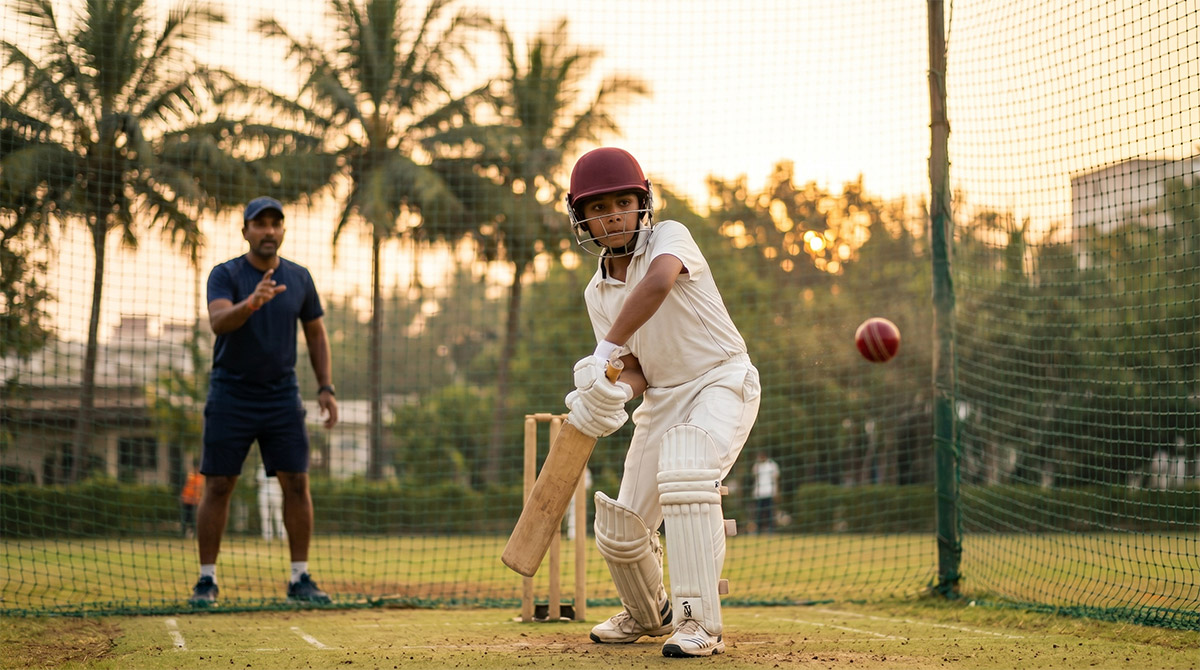
In November 2024, a 13-year-old boy from Tajpur village in Bihar walked out of the IPL mega auction with a ₹1.10 crore Rajasthan Royals contract. Vaibhav Suryavanshi became the youngest player ever picked in the IPL. His first formal coaching had started seven years earlier at a small academy in Patna. That is the dream every parent has in mind when they Google "cricket academy near me".
Now the math behind that dream. India has roughly 6,000 BCCI-registered cricketers across all states and age groups. Around 15 men make their international debut for India each year. The senior men's central contract list has fewer than 30 names. Even Ranji Trophy spots are tight: 38 teams, 11 starters each, and competition for those slots starts in U-14 trials.
Joining a cricket academy is the first step into that funnel. Picking the right one matters more than most parents realise. This guide is the unfiltered version: what to do, what not to pay for, what coaches actually look for, and the cost of cricket coaching in India in 2026.
Quick answers (for parents who are skimming)
| Best age to start formal academy training | 8 to 12 years |
| Is 16 or 18 too late? | No. MS Dhoni began serious training in his late teens. Most academies accept students up to 18. |
| Average monthly fees in 2026 | ₹2,500 to ₹8,000 in Tier-2 and Tier-3 cities. ₹6,500 to ₹40,000 in metros. |
| Premium academies (annual) | ₹50,000 to ₹2,00,000+ at Padukone-Dravid Centre, KIOC, Sehwag Academy, Vengsarkar Academy |
| Documents needed | Aadhaar or birth certificate, school ID, four passport-size photos, proof of address, medical fitness note |
| What coaches look for in trials | Hand-eye coordination, footwork, throwing arm, attitude. Polish comes later. Raw athleticism is harder to teach. |
| Direct route to NCA Bengaluru? | None. NCA is invitation-only through BCCI age-group performance. |
Step 1: Be honest about the goal
Before you pick an academy, decide what you actually want from it. Three common goals look very different in practice.
Goal A: General development for school cricket and fitness. This is most kids. A neighbourhood academy with 10 to 15 students per coach, three sessions a week, and basic turf or matting nets is enough. You do not need to overpay for facilities your child will not use.
Goal B: Serious competitive cricket through age-group state teams. Roughly the top 5% of academy students. You need an academy that already feeds the local district cricket association, runs internal tournaments, and has put students into state age-group teams in the last two years. Ask for names. Cross-check those names on the state association website or Cricbuzz.
Goal C: Ranji Trophy and IPL ambitions. Less than 1% of academy students. This needs an academy with direct district and state coach connections, residential or near-residential training, and four to six hours of cricket a day. The cost roughly triples. The time commitment for the family roughly quadruples, because schools start to take a back seat.
The single biggest waste of money in Indian cricket coaching is parents paying Goal C fees when their child only needs Goal A. Pick the goal honestly. You can always upgrade if performance demands it.
Step 2: Understand the four tiers of cricket academies in India
Cricket academies in India fall into four broad tiers. Knowing which one you are talking to changes the questions you ask and what you should pay.
| Tier | Examples | What you get | Annual fees |
|---|---|---|---|
| Local academy | Neighbourhood academies, school-affiliated programmes | Group coaching, basic nets, fitness drills | ₹15,000 to ₹50,000 |
| State-affiliated academy | Academies registered with state cricket associations | Pathway to district and state trials, qualified coaches, video analysis | ₹40,000 to ₹1,20,000 |
| Premium private academy | KIOC Bengaluru, Sehwag Cricket Academy Jhajjar, Padukone-Dravid Centre, Vengsarkar Academy Mumbai, VB Cricket Academy Chennai | Former first-class coaches, residential options, video analysis labs, international tours | ₹1,50,000 to ₹4,00,000+ |
| BCCI National Cricket Academy | NCA Bengaluru | Invitation-only via age-group BCCI performance, fully sponsored | Not retail |
The National Cricket Academy in Bengaluru, alma mater of Virat Kohli, Rohit Sharma, Rahul Dravid, KL Rahul, and Hardik Pandya, does not take walk-in admissions. Players are identified through BCCI age-group tournaments (U-15 Vijay Merchant Trophy, U-17, U-19 Cooch Behar Trophy, U-23) and called up to NCA camps after that. The new 40-acre NCA near Bengaluru airport, with three full grounds and 40 practice pitches, is for invited players only.
Most articles online quote NCA fees of ₹3,150. That is a one-time enrolment charge BCCI applies to its already-invited players. It is not a public admission route. Anyone offering "guaranteed NCA admission" for a fee is selling a story that does not exist.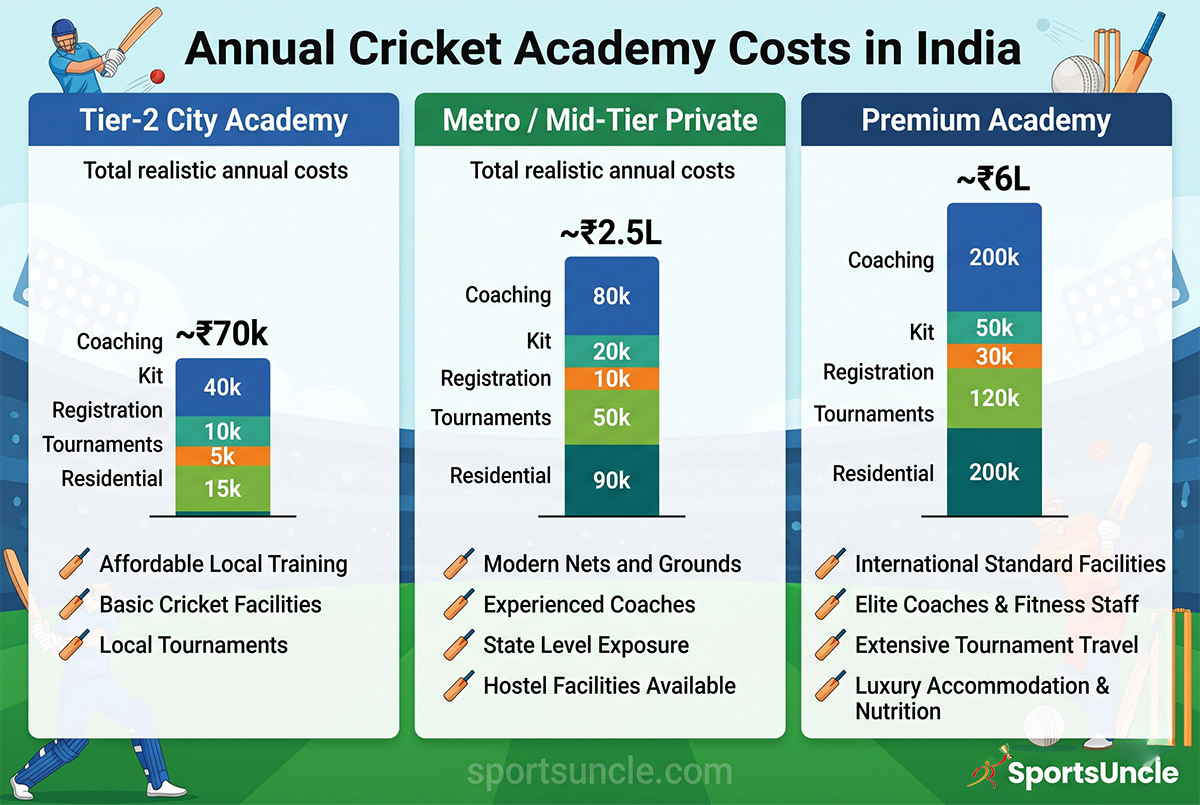
Step 3: How to find a good cricket academy near you
Start with one filter: distance. Players who pick an academy within 30 minutes of home show up to 40% more sessions over a year than those who commute longer. Talent does not survive missed practice. Convenience compounds.
Once you have three or four shortlisted academies in range, evaluate them on five things, in this order:
- Coach background. Ask: was the head coach a Ranji or first-class player? If not, do they hold a BCCI Level 2 or Level 3 certification? "Ex-international coach" claims are common and rarely true. A Level 2 BCCI-certified coach who played Ranji is genuinely good. A "former player" who played one club match is not.
- Where do their students play? A serious academy will name 5–10 students from the last two batches who reached district, state age-group, or U-19 levels. If they cannot, the academy is not a feeder.
- Coach-to-student ratio. Anything worse than 1:15 in a group session is a daycare with bats. Look for 1:8 to 1:12 in skill sessions.
- Facility basics. Two turf nets, one cement net, a designated catching and fielding area, and a bowling machine cover the actual training needs. Indoor halls and air-conditioned gyms are nice. They are not what makes you a cricketer.
- Match exposure. Net practice without matches is shadow boxing. Ask how many internal and external matches students play in a year. Anything below 15 is too few.
One quick honesty test: visit on a regular weekday afternoon, not on a scheduled trial day. The atmosphere on a normal Wednesday is what your child will get for the next year.
Step 4: The right age to start cricket academy training
The honest answer is staged. Different ages need different things.
- Ages 5 to 7: Soft-ball coaching. Hand-eye coordination, basic throwing, basic running. Two days a week is plenty. Heavy technical correction at this age stiffens kids up and kills the love of the game.
- Ages 8 to 12: The real start. This is when grip, stance, footwork, and bowling action are formed. A child who clears age 12 with a clean technique has a structural advantage that lasts for years. This is also when fitness habits stick.
- Ages 13 to 15: Match cricket starts to matter as much as net practice. Push for school, district, and U-14/U-16 selections. Specialise: opener, finisher, pacer, spinner, keeper. Generalists get filtered out at this stage.
- Ages 16 to 18: If state age-group selections are not happening by now, the realistic ceiling shifts to club, university, or recreational cricket. That is not a failure; it is information. Plenty of careers are built around cricket without playing it professionally: coaching, sports management, sports physiotherapy, sports media.
- Ages 18 and above: Late starters can still play strong club, corporate, and league cricket. The Ranji and IPL door narrows sharply, but it does not fully shut for outliers. You will need a focused 18-month plan, a residential or semi-residential setup, and a coach willing to back you.
If you only remember one thing from this section: start when the child is interested, not when the parent is excited.
Step 5: Cricket academy fees in India in 2026
Real cricket coaching costs are higher than the brochure number. Here is the honest break-up for a serious annual budget.
| Item | Tier-2 city | Metro / mid-tier private | Premium academy |
|---|---|---|---|
| Coaching fee (annual) | ₹30,000–₹60,000 | ₹72,000–₹1,80,000 | ₹2,00,000–₹4,80,000 |
| Registration / admission | ₹2,000–₹5,000 | ₹5,000–₹15,000 | ₹10,000–₹25,000 |
| Personal cricket kit (year 1) | ₹6,000–₹12,000 | ₹10,000–₹20,000 | ₹15,000–₹35,000 |
| Replacement gear (annual) | ₹3,000–₹6,000 | ₹5,000–₹10,000 | ₹8,000–₹20,000 |
| Tournament fees, travel, accommodation | ₹5,000–₹10,000 | ₹15,000–₹40,000 | ₹40,000–₹1,20,000 |
| Residential / hostel (if applicable) | — | ₹60,000–₹1,50,000 | ₹1,80,000–₹3,60,000 |
| Realistic annual total | ₹46,000–₹93,000 | ₹1,07,000–₹4,15,000 | ₹2,73,000–₹10,40,000 |
A few things to budget honestly for, that brochures do not list:
- Outstation tournament travel for the family. Parents end up travelling with U-12 and U-14 kids. Hotels, food, train tickets stack up.
- Bat replacements. A serious junior cricketer in regular match practice goes through a bat every 8 to 12 months. Quality willow bats start at around ₹5,000 and go up to ₹25,000.
- Cricket shoes. One spike pair, one rubber pair, replaced annually as the foot grows. Budget ₹4,000–₹8,000 a year between the two.
- Physio and sports medicine. Adolescent cricketers often hit growth-plate issues, lower-back stress, and shoulder strain. Budget for at least two physio consults a year.
For families building the kit from scratch, our cricket category covers gear from beginner to academy-level price points. Our breakdown of the SuperJockk 2100D wheel cricket kit bag is a good starting point if you are setting up a serious junior player and need a kit bag that survives daily academy use.
Step 6: Documents and admission paperwork
Most Indian cricket academies ask for a near-identical document set. Have these ready before you visit:
- Birth certificate or Aadhaar (age proof is critical because age-group cricket is strict)
- Recent school ID or Bonafide certificate
- Four passport-size photographs
- Proof of residence (Aadhaar, electricity bill, rent agreement)
- Parent or guardian ID and contact details
- Basic medical fitness certificate from a registered doctor
- Filled academy registration form
- Payment of registration fee (almost always non-refundable, so do not pay until you are sure)
One paperwork detail many parents miss: BCCI age-group cricket uses the date of birth on official records. If your child has a discrepancy between school records and the birth certificate, fix it before academy admission. Age-fudging gets caught at state trials through bone-density testing, and a flagged player is banned from BCCI cricket for two years. It is the single most common reason talented players have their state careers ended at 14 or 15.
Step 7: Preparing for cricket academy trials
Some academies admit anyone who pays. Better academies run a trial. The trial usually lasts 30 to 90 minutes per candidate and covers four areas.
| Trial section | What coaches assess | Weight |
|---|---|---|
| Batting | Grip, stance, balance, head position, ability to play straight, footwork against pace and spin | 30–40% |
| Bowling | Run-up rhythm, action repeatability, release, line and length, ability to bowl six legitimate balls in a row | 30–40% |
| Fielding and throwing | Catching (both hands), ground fielding, throwing arm, run-and-pick | 15–20% |
| Fitness and athleticism | 20-metre sprint, run-a-three, agility shuttle, basic strength markers | 10–20% |
What I have seen across multiple academy trials, and what coaches I have spoken to confirm: at U-12 and U-14 trials, fielding and throwing arm carry far more weight than parents expect. A child who throws cleanly from 30 metres with one bounce will be remembered. A child who is a clean technical batter but fields like a brick will not. Throwing well is harder to teach than batting well, so coaches prioritise it.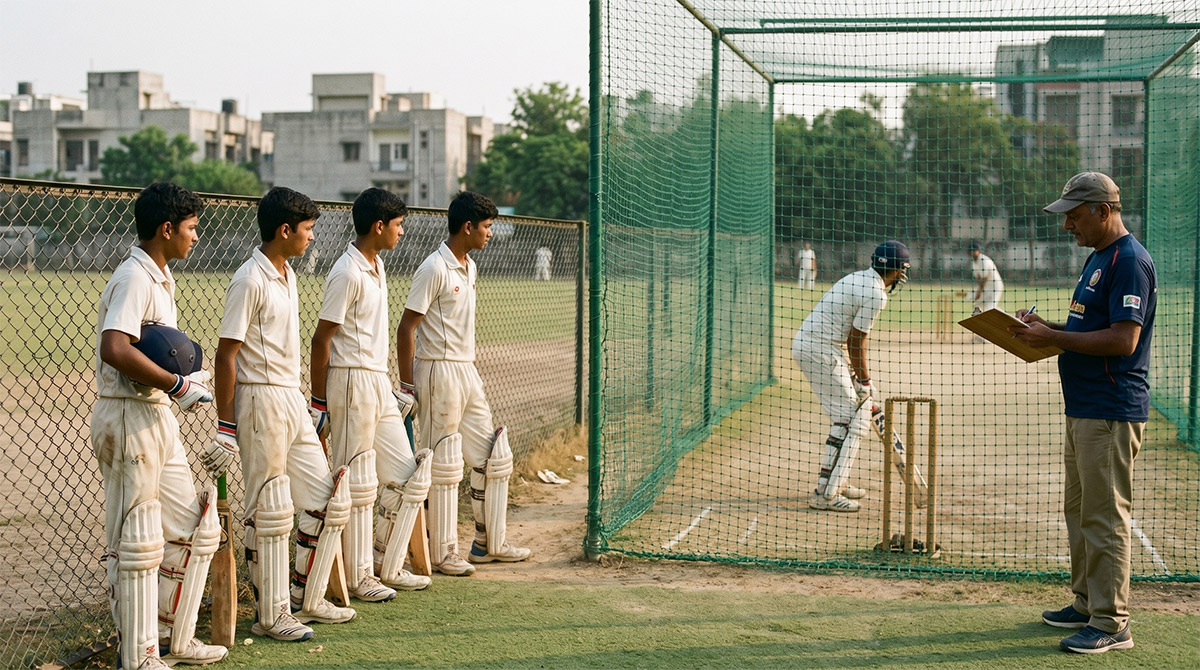
How to prepare for the trial in 30 days
- Practice catching daily. 50 high catches and 50 close catches a day. Get a parent or sibling to feed.
- Throw a target at a wall every day. Distance: 25 to 35 metres. Aim for accuracy first, then add velocity.
- Bowl one over a day, properly. Six balls, full run-up, against a mark. Do not bowl tired.
- Bat for 20 minutes a day with a hard ball, ideally with someone who can bowl two pace lengths. Throwdowns work fine.
- Run 400 metres three times a week, finishing each in under 95 seconds for a U-14, under 80 seconds for U-19.
- Sleep 9 hours the night before the trial. Eat normally. Do not change anything.
One unfashionable piece of advice: dress like a serious cricketer, not like a tournament finalist. Plain whites, clean shoes, properly worn pads. Coaches register fussiness as a red flag. Bright stickers and over-the-top wristbands tell them you spent the morning thinking about your look instead of your game.
Step 8: Cricket equipment for academy admission
Most academies will tell you "kit not required for trials" and then quietly favour the kid who showed up properly equipped. The minimum set for academy training, regardless of age:
- Cricket bat in the right size (Size 5 for ages 9–11, Size 6 for 11–13, Harrow for 13–14, Short Handle for 15+)
- Helmet with grille (non-negotiable from age 8 upwards)
- Batting gloves and batting pads in matching size
- Abdominal guard (boys) or chest guard and abdominal guard (girls)
- Thigh pad and inner thigh pad
- Wicket-keeping gloves and inners (only for keepers)
- Cricket shoes with spikes for turf, rubber-sole pair for matting and concrete
- Cricket whites, cap, and a kitbag with wheels (a wheelie kit bag matters when a child carries it daily)
- Two cricket balls (one tennis-tape ball and one season ball) for personal practice
You can put together a serviceable beginner academy kit in the ₹8,000–₹14,000 range. A serious U-16 kit lands closer to ₹25,000–₹40,000 once you factor in spike shoes and a quality bat.
If you are setting up from scratch, our cricket shoes range covers both spike and rubber options for academy use, and the broader cricket gear catalogue walks you through bats, kit bags, and protective wear by age group.
Step 9: The first 30 days at a cricket academy
The first month is the one where good habits set or bad ones get baked in. A few things every new academy student should do:
- Arrive 15 minutes early every session. The kid who is changing while the warm-up starts gets noticed for the wrong reason.
- Carry your own kit. Coaches notice who depends on parents to carry pads.
- Speak to the coach in the first session. Tell them, in one sentence, what you want to work on. They will remember the child who introduced himself or herself.
- Keep a one-line journal after every session: what went well, what did not. Re-read every Sunday.
- Do not skip fitness. Indian academy culture under-trains fitness because batting and bowling are more visible. The kids who eventually convert to state level are usually the ones who took the boring fitness sessions seriously at age 12.
Government academies, scholarships, and free cricket coaching in India
Cricket coaching is expensive. Three legitimate routes around the fees:
Sports Authority of India (SAI) cricket centres. SAI runs a Khelo India scheme with cricket coaching for selected athletes at minimal cost. Selection is through Khelo India Youth Games and SAI-affiliated district trials. Free residential and training facilities are provided to selected players.
State cricket association academies. Karnataka State Cricket Association (KSCA), Mumbai Cricket Association (MCA), Tamil Nadu Cricket Association (TNCA), and Delhi & District Cricket Association (DDCA) all run subsidised or free coaching for players who clear district-level trials. The route is: register at a club affiliated to the state association, perform in zonal matches, get nominated for state academy trials.
Private academy scholarships. Most premium academies, including Sehwag Cricket Academy, Padukone-Dravid Centre, and Madan Lal Cricket Academy, run partial or full scholarships for promising players from financially constrained backgrounds. The amount typically covers training fees and partial accommodation, not equipment or travel. Scholarship rounds usually happen once a year. Apply directly through the academy's official website. Avoid agents.
One eye-opening number: the BCCI's annual revenue in financial year 2023–24 was ₹18,700 crore. Less than 5% of that flows into grassroots and academy infrastructure. The funnel is paid for mostly by parents, not by the system that benefits from the funnel. That is just the structural reality of cricket in India in 2026, and it is worth knowing before you commit financially.
The brutal truth about cricket as a career
Let me be direct about something most cricket academy guides skip.
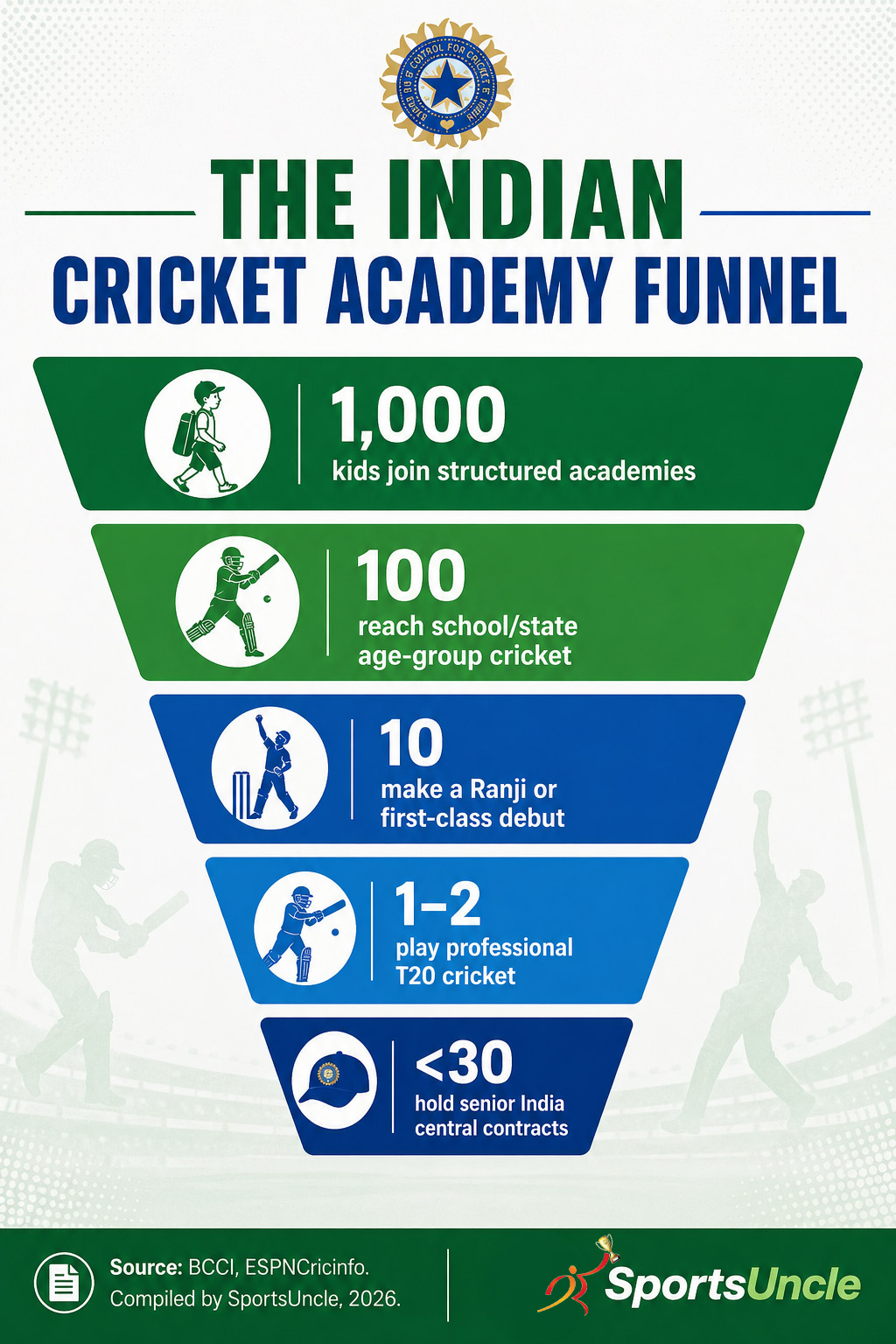
Of every 1,000 children who join a structured cricket academy in India, roughly 100 reach school-state-level age-group cricket. About 10 reach a Ranji or domestic first-class debut. Roughly one or two of those will play a professional T20 league. The path to senior India cricket is a single-digit number per year.
This does not mean cricket academies are a bad investment. It means you should join one for the right reason. Cricket teaches discipline, fitness, hand-eye coordination, teamwork, and how to lose. Those carry into every other career a child eventually chooses. Treat the academy as the foundation of an athletic, disciplined adolescence first, and a career path second. The kids who succeed in cricket usually had parents who took this view from the start.
If your child reaches state age-group level, the conversation about full-time cricket starts properly. Until then, balance education and training. Vaibhav Suryavanshi is the exception, not the rule. The rule is: study hard, train hard, decide later.
Frequently asked questions
1. What is the right age to join a cricket academy in India?
Eight to twelve years is the ideal window for serious technical training. Younger children (5–7) can start with soft-ball coaching for coordination. Teenagers up to 18 are accepted at most academies and can still build a competitive cricket career.
2. How much does a cricket academy cost in India in 2026?
Local academies in Tier-2 cities: ₹2,500 to ₹5,000 a month. Metro academies: ₹5,000 to ₹15,000 a month. Premium private academies (KIOC, Sehwag, Padukone-Dravid, Vengsarkar): ₹50,000 to ₹2,00,000+ per year. Add another 30–50% for kit, tournament fees, and travel.
3. Can I join the National Cricket Academy in Bengaluru directly?
No. NCA is BCCI-run and admits players only by invitation, based on performance in BCCI age-group tournaments (U-15, U-17, U-19, U-23). There is no public admission route. Anyone offering paid NCA admission is misleading you.
4. Is 16 too late to start cricket coaching seriously?
No. It is later than ideal, but not too late. With a structured 18-month plan, fitness work, and a coach willing to back you, club, university, and corporate cricket are open. Ranji and IPL routes narrow sharply but stay possible for outliers.
5. What documents are needed for cricket academy admission?
Birth certificate or Aadhaar, school ID, four passport-size photos, proof of address, parent or guardian ID, basic medical fitness certificate, and a filled academy registration form. Match the date of birth across all documents to avoid age-group cricket bans later.
6. What do coaches look for in a cricket academy trial?
Hand-eye coordination, balance, footwork, throwing arm, attitude. Polish in batting or bowling helps but is teachable. Raw athletic ability and clean throwing are harder to teach and are weighted heavily, especially in U-12 and U-14 trials.
7. Are there scholarships or free cricket academies in India?
Yes. The Sports Authority of India runs cricket coaching under the Khelo India scheme. State cricket associations like KSCA, MCA, TNCA, and DDCA offer subsidised or free coaching for district-trial qualifiers. Most premium private academies run partial scholarships through their official websites once a year.
8. How long does it take to go from academy to professional cricket?
For the small percentage who reach professional cricket, the typical timeline is 8 to 12 years from first academy admission to a Ranji debut. IPL contracts come either through state cricket performance or, less commonly, IPL franchise scouting trials.
9. What equipment do I need to bring to a cricket academy?
Bat in the correct size, helmet with grille, batting gloves, batting pads, abdominal guard, thigh pad, cricket shoes (spikes for turf, rubber for matting), cricket whites, and a kit bag. A beginner academy kit costs around ₹8,000 to ₹14,000.
10. How do I know if a cricket academy is good?
Five tests: head coach is a former first-class player or BCCI Level 2 certified, the academy has put students into district or state age-group teams in the last two years, coach-to-student ratio is 1:8 to 1:12 in skill sessions, basic facilities (turf nets, fielding area, bowling machine), and at least 15 internal or external matches a year. Visit on a regular weekday before paying.
11. Can girls join cricket academies in India?
Yes. Most academies admit girls, and a few (like NCA) run dedicated women's coaching programmes. Indian women's cricket has grown sharply since the 2017 World Cup final and the WPL launch in 2023, and several state academies now offer fee waivers to encourage women's cricket participation.
12. What is better, a cricket academy or personal coaching?
Both, in sequence. Personal coaching is useful for fixing a specific technical fault. Academies are essential for match exposure, peer competition, and the social structure that turns a child into a cricketer. A child who only does personal coaching usually freezes in a real match. Match cricket cannot be simulated one-on-one.
Final word
Picking a cricket academy is a decision that affects the next decade of a child's life. Take it seriously. Do the visits, asks the awkward questions about ex-students and qualifications, and start with a goal that matches the player rather than the parent's ambition. The right academy, joined for the right reason, is one of the best things sport can give a child in India. The wrong one, joined for the wrong reason, is an expensive way to learn that lesson.
For cricket gear, kits, footwear, and protective equipment for academy training, our cricket store stocks options across price tiers, from beginners' first kits to U-19 academy-level setups.

Viswanath M
Meet the maestro behind the cricketing quill – a wordsmith whose ink flows with the rhythm of a perfectly timed cover drive. When the cricket ball rests, my pen takes the spotlight, transforming every match, every player, into a poetic symphony of leather against willow. With a laptop as my crease and words as my bouncers, I bowl over readers with stories that swing and spin.
Leave a Reply
Your email address cannot be published. Required fields are marked*
Latest Articles from Blog
07.09.2026
23.08.2026
No comments