

Loading cart...
 My Account
 Track Order
 Sports Guide
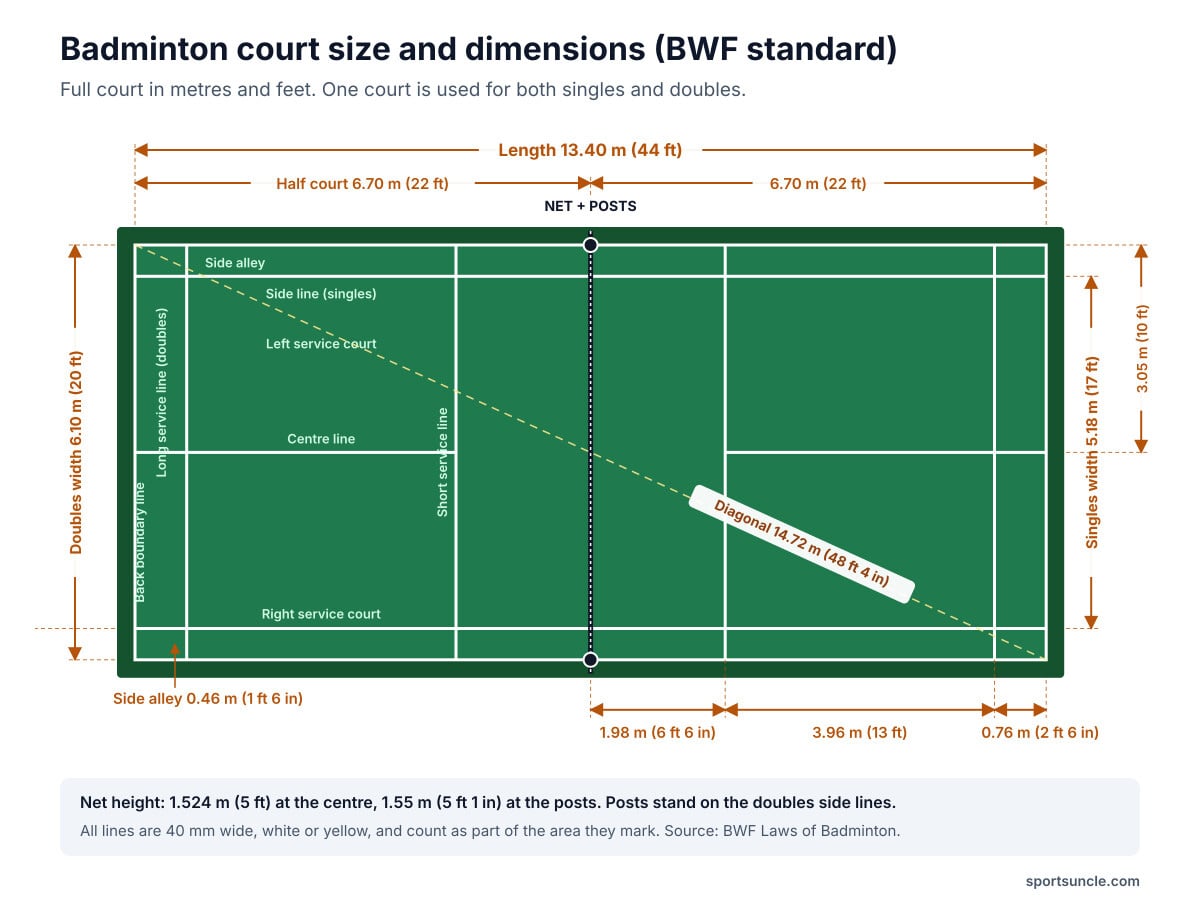
A badminton court is 13.40 m long and 6.10 m wide (44 ft × 20 ft) for doubles. For singles, you use the same length but only 5.18 m (17 ft) of the width. The net is 1.524 m (5 ft) high at the centre and 1.55 m (5 ft 1 in) at the posts.
Those numbers come from Law 1 of the BWF Laws of Badminton. They apply everywhere, from the Olympics to a society court in your colony. Below you'll find every line measurement in metres and feet, the net specs, and how much space and ceiling height you actually need if you are planning a court.
Quick answer
- Doubles court: 13.40 m × 6.10 m (44 ft × 20 ft)
- Singles court: 13.40 m × 5.18 m (44 ft × 17 ft)
- Net height: 1.524 m (5 ft) at the centre, 1.55 m (5 ft 1 in) at the posts
- Line width: 40 mm, and every line counts as part of the area it marks
- Area: about 81.7 m² (880 sq ft) for doubles, 69.4 m² (747 sq ft) for singles
Badminton court dimensions in metres and feet
| Measurement | Metres | Feet |
|---|---|---|
| Court length (singles and doubles) | 13.40 m | 44 ft |
| Doubles width | 6.10 m | 20 ft |
| Singles width | 5.18 m | 17 ft |
| Each half (net to back line) | 6.70 m | 22 ft |
| Net to short service line | 1.98 m | 6 ft 6 in |
| Back line to doubles long service line | 0.76 m | 2 ft 6 in |
| Side alley (between singles and doubles side lines) | 0.46 m | 1 ft 6 in |
| Diagonal of the full court | 14.723 m | 48 ft 4 in |
| Line width | 40 mm | about 1.6 in |
| Net height at centre | 1.524 m | 5 ft |
| Net height at posts | 1.55 m | 5 ft 1 in |
Feet values are rounded. BWF publishes the official figures in metres.
Singles vs doubles: what actually changes
Nothing on the floor changes. One court is marked for both games. What changes is which lines count.
- Singles uses the inner side lines, so the court is 5.18 m wide. The full 13.40 m length is in play, right up to the back boundary line.
- Doubles uses the outer side lines, so the court is 6.10 m wide. The two 0.46 m strips on the sides, called side alleys, come into play.
- Serving is where it gets tricky. In doubles, a serve must land in front of the long service line, which sits 0.76 m inside the back line. After the serve, the whole back area is in again.
Our badminton rules guide explains serving and scoring line by line, including the 15-point scoring that starts on 4 January 2027. The 2027 Laws don't change any court or net measurements.
Service court size
| Service court | Length | Width |
|---|---|---|
| Singles (short service line to back boundary line) | 4.72 m (15 ft 6 in) | 2.59 m (8 ft 6 in) |
| Doubles (short service line to doubles long service line) | 3.96 m (13 ft) | 3.05 m (10 ft) |
So the singles service court is long and thin, and the doubles one is short and wide. It's one reason singles players often serve long and high, while doubles players mostly serve short: the doubles service court is only 3.96 m deep.
Badminton net height and size
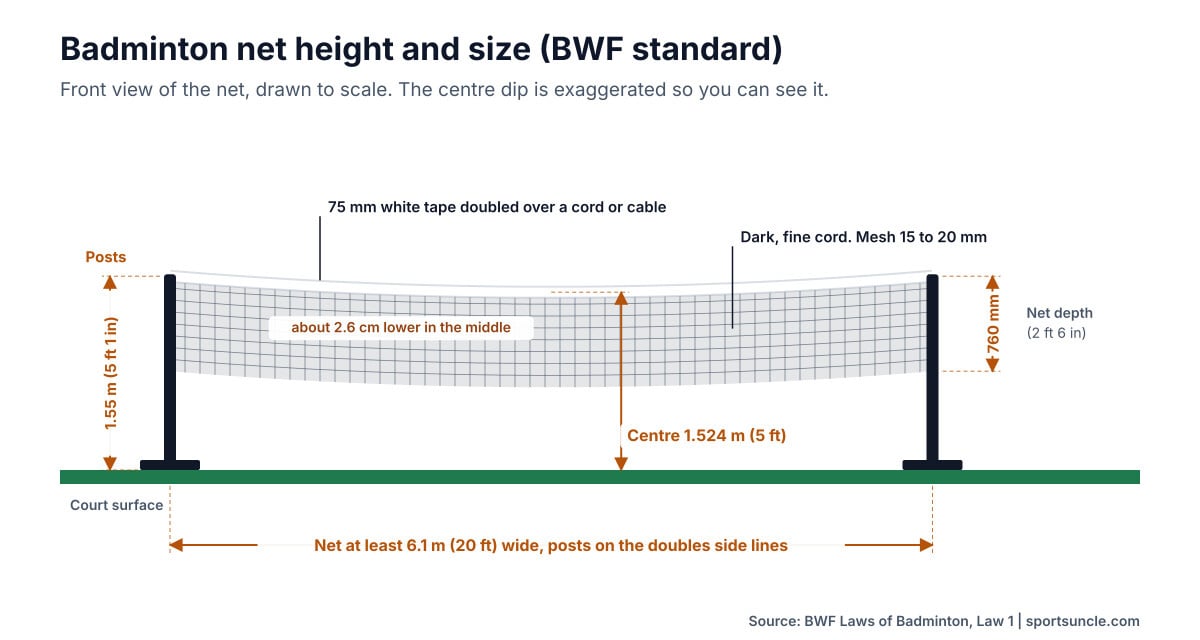
The top of the net must be 1.524 m (5 ft) above the floor at the centre of the court and 1.55 m (5 ft 1 in) over the doubles side lines. That difference of about 2.6 cm is the sag you get when a net is pulled tight between two posts. BWF builds it into the rule instead of pretending the net hangs perfectly flat.
A few sites swap these two numbers. Remember it this way: the posts are the higher point and the middle is lower.
- Posts: 1.55 m tall, standing on the doubles side lines. They stay there even for singles.
- Net depth: 760 mm (2 ft 6 in) from top to bottom.
- Net width: at least 6.1 m, with no gap between the net ends and the posts.
- Mesh: dark, fine cord with holes between 15 mm and 20 mm.
- Top tape: 75 mm white tape folded over a cord or cable, which is stretched tight and flush with the top of the posts.
How to check your net: measure from the floor to the top of the tape at the centre. You want 5 ft (152.4 cm). Then measure over each doubles side line for 5 ft 1 in (155 cm). Nets stretch with use, so check every few weeks again. If the middle has dropped, tighten the cord rather than adding a prop under the net.
Need a new net? The Yonex BN-139A is a nylon net built for club and school courts. The Li-Ning LN2100 is a full-size 22-ply nylon net for courts that see daily play. If you're buying posts or a stand separately, check that they give 1.55 m at the top. See all badminton accessories.
How much space and ceiling height does a badminton court need?
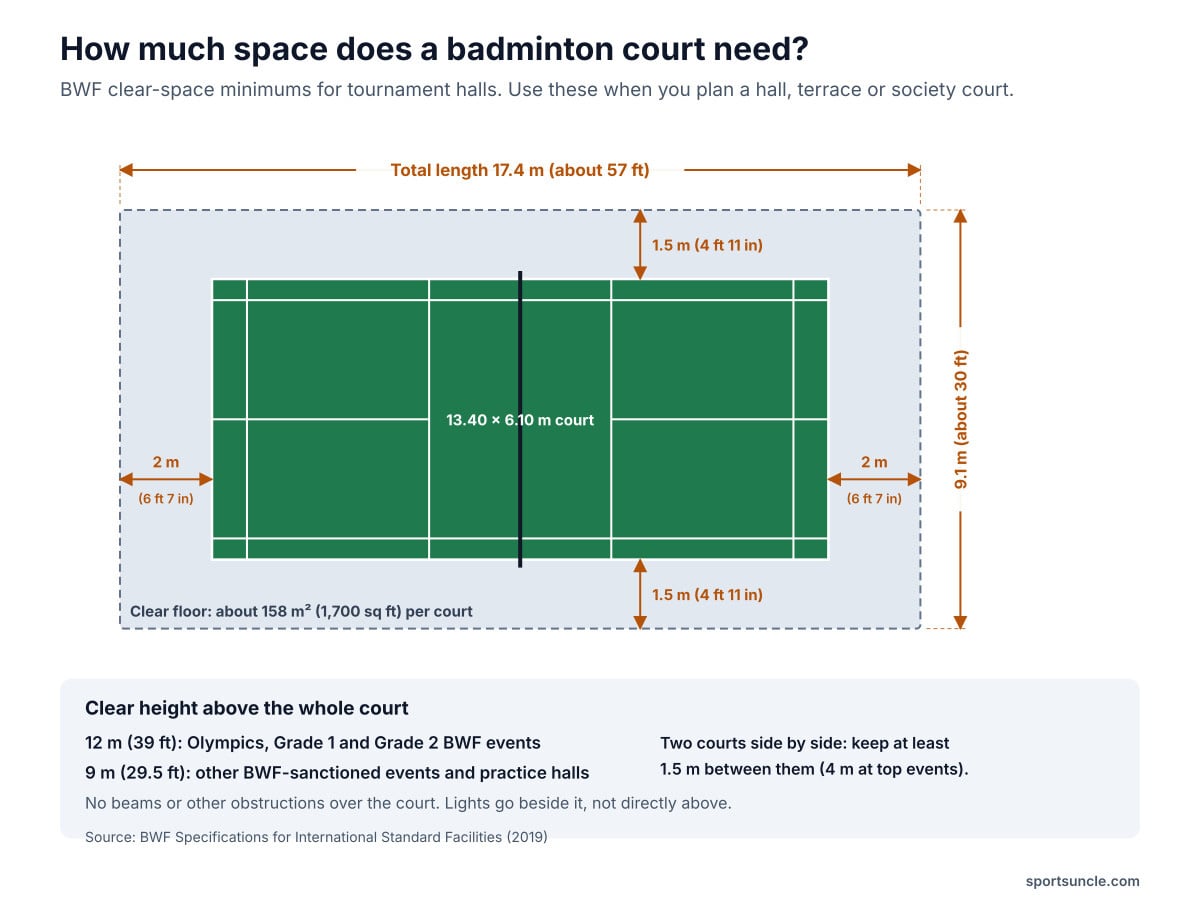
The court lines are only part of it. Players run and lunge past the lines, and a high clear needs room above. BWF's facility specifications for international events ask for:
- Behind each back line: at least 2 m of clear space
- Beside each side line: at least 1.5 m
- Between two courts: at least 1.5 m, and 4 m is recommended at top events
- Clear height over the whole court: 12 m (39 ft) for the Olympics and Grade 1 and 2 events, and 9 m (29.5 ft) for other BWF-sanctioned events and practice halls. No beams or other obstructions should be over the court.
Add those up, and one court needs a clear floor of about 17.4 m × 9.1 m (57 ft × 30 ft). That's roughly 158 m², or 1,700 sq ft. Two courts side by side, with 1.5 m between and beside them need about 16.7 m of width.
These are tournament minimums. A society or terrace court for casual play can get away with less run-off. But keep the full 13.40 m length if you can, because a shorter court changes every clear and drop. And give yourself as much ceiling as possible. A low roof is the first thing that ruins a home court.
Lighting, floor and air: what BWF asks for
- Lighting: at least 1,000 lux, spread evenly over the court, for Grade 1 and 2 events. Lights shouldn't hang directly over the playing area. BWF prefers them along the sides, and any daylight behind or beside the court should be blocked out.
- Background: the wall behind each end shouldn't be white or light-coloured, and BWF recommends against a light ceiling too. A white shuttle disappears against a white wall.
- Air: airflow over the court shouldn't go above 0.2 m/s. In practice, that means a ceiling fan or an AC vent blowing across the court will push the shuttle around.
- Floor: top events use a wooden sprung floor with approved court mats on top.
- Temperature: between 18 and 30 °C. Temperature also changes how fast a feather shuttle flies, which is why shuttles come in speed grades. Our shuttlecock speed selector helps you pick one for your hall.
Playing on wood or a synthetic mat? Wear badminton shoes with gum rubber soles. Running shoes can slip and leave marks. Here's why non-marking shoes matter.
How to mark a badminton court
If you are taping or painting a court yourself, this order keeps it square.
- Mark one back boundary line 6.10 m (20 ft) long.
- From each end, run the doubles side lines 13.40 m (44 ft) at right angles and join them with the second back line.
- Check both diagonals. Each should be 14.723 m (48 ft 4 in). If they differ, the court isn't square, so adjust before going further.
- Mark the net line across the middle, 6.70 m (22 ft) from each back line. The posts go on the doubles side lines here.
- Mark the short service lines 1.98 m (6 ft 6 in) from the net on both sides.
- Mark the doubles long service lines 0.76 m (2 ft 6 in) inside each back line.
- Mark the singles side lines 0.46 m (1 ft 6 in) inside each doubles side line.
- Draw the centre line from each short service line to the back line, splitting each half into left and right service courts.
Use 40 mm wide lines in white or yellow, so they stand out against the court surface. The lines are part of the court, so a shuttle that touches any part of a line is in.
Is a pickleball court the same size as a badminton court?
Yes, on the floor. A pickleball court is 20 ft × 44 ft, exactly the size of a badminton doubles court. The nets are different. A pickleball net is 36 in at the sidelines and 34 in at the centre, which is about 2 ft lower than a badminton net. If your club wants both sports, you can tape pickleball lines on the same floor and swap nets. Browse our pickleball range if your club is adding it.
What about outdoor badminton?
The standard court doesn't change outdoors. The Laws are the same, but wind makes a feather shuttle almost unplayable. For outdoor play, BWF created AirBadminton with its own court:
- 16 m × 6 m for doubles and triples, 16 m × 5 m for singles
- a 2 m dead zone in front of the net on each side, where the shuttle can't land
- a lower net, 1.45 m at the centre
For backyard or terrace games with a regular net, mark the standard court and use a nylon shuttle. It handles a light breeze better than feather.
Frequently asked questions
What is the size of a badminton court in feet?
44 ft long and 20 ft wide for doubles. A singles court is 44 ft long and 17 ft wide.
What is the size of a badminton court in metres?
13.40 m long and 6.10 m wide for doubles, and 13.40 m × 5.18 m for singles.
How many square feet is a badminton court?
A doubles court is about 880 sq ft (81.7 m²). A singles court is about 747 sq ft (69.4 m²). With BWF's clear space around it, plan for about 1,700 sq ft per court.
What is the height of a badminton net?
5 ft (1.524 m) at the centre and 5 ft 1 in (1.55 m) at the posts on the doubles side lines.
What is the badminton net height in cm?
152.4 cm at the centre and 155 cm at the posts. The net itself is 76 cm deep.
Is the net height different for singles and doubles?
No. The net and posts stay in the same place at the same height. The posts always stand on the doubles side lines.
How long is a badminton net?
At least 6.1 m (20 ft) wide, so it covers the full doubles width with no gap at the posts.
How high should the ceiling be for badminton?
BWF needs 12 m (39 ft) of clear height for its top events and 9 m (29.5 ft) for other sanctioned events and practice halls. For casual play, go as high as your space allows.
Badminton court ka size kitna hota hai?
Doubles court 44 feet lamba aur 20 feet chauda hota hai (13.40 m × 6.10 m). Singles mein chaudai 17 feet (5.18 m) hoti hai. Net ki height beech mein 5 feet aur posts par 5 feet 1 inch hoti hai.

Vijaydeep Saini
Smashing sentences and shuttlecocks with equal precision. A wordsmith on the court and an athlete at the keyboard, serving aces and anecdotes. Pen in hand, racket ready—let’s play.
Leave a Reply
Your email address cannot be published. Required fields are marked*
Latest Articles from Blog
No comments