

Loading cart...
 My Account
 Track Order
 Sports Guide
By Aashish Rrastogi, founder of SportsUncle. I have been in the Yonex badminton trade since 2012. Facts checked against the sources listed at the end, November 2026.
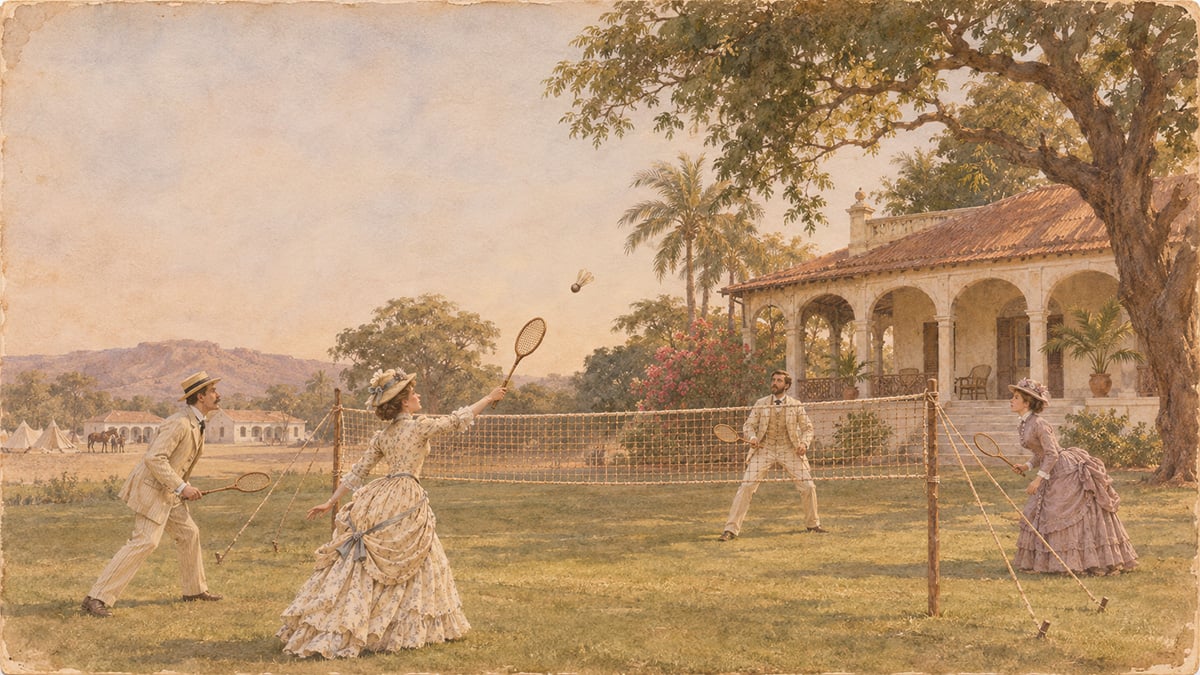
Short answer: In the 1860s and 1870s, British officers and civil servants in India played a game with a shuttlecock and a net. It was also called "Poona" (or "Poonah"), after the garrison town of Pune, where it was especially popular.
Most encyclopaedias say the first rules were drawn up in Poona in 1873. The name "badminton" comes from Badminton House, the Duke of Beaufort's estate in Gloucestershire, England. Nobody has found a record that explains exactly when or why that name stuck.
What "Poona" actually was
Poona was not a separate sport that later turned into badminton. It was an early form of badminton itself, under a local nickname.
The older parlour game, battledore and shuttlecock, was about keeping the shuttle in the air. Put a string or net between two sides, and it becomes a contest. That is the game British India played.
- Who played it: British civil servants, their families and Indian Army officers. Indians were mostly shut out of these colonial social circles in the 1860s and 1870s.
- Where: mostly outdoors, on lawns in hill stations and cantonments such as Simla, Murree, Nagpur (then Nagpore), Calcutta and the Poona region.
- Its reputation: a gentle pastime, often described as a game for ladies. An 1864 photograph is captioned "A relaxation for the ladies, brought from Europe."
- How popular it got: popular enough that in February 1877 the Times of India reported the Bishop of Madras protesting against "Sunday badminton" from his pulpit.
Poona is also not the same as ball badminton. That is a separate Indian sport from Thanjavur (Tanjore), played as early as 1856 with a woollen ball. The National Badminton Museum notes that ball badminton was also called "Poona" in its early days. That shared nickname explains much of the confusion online.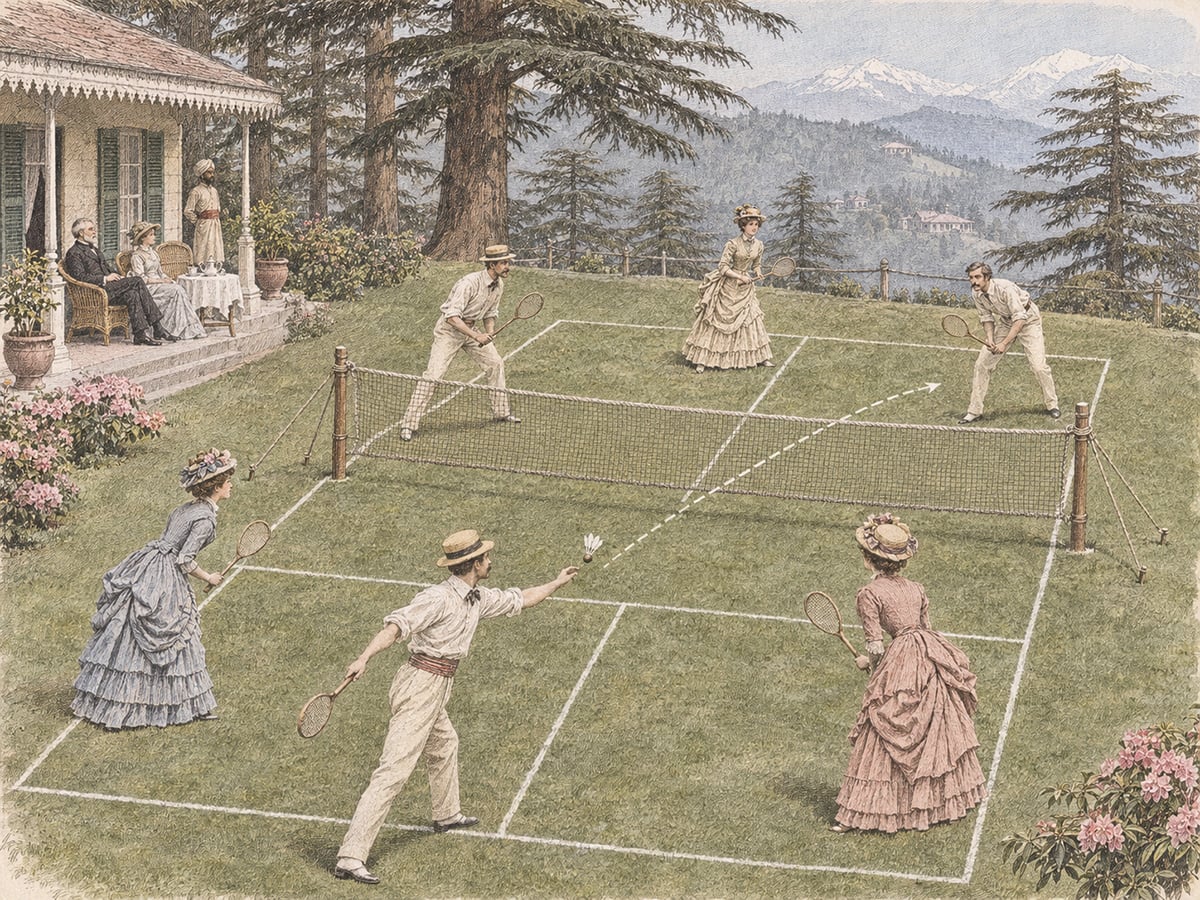
How the game was played in the 1870s
The best detailed description from the period is the badminton entry in the 1875 Encyclopaedia Britannica. It was written by Henry Jones ("Cavendish"), who refereed the first Wimbledon tennis championship in 1877. Put it alongside the rule sets printed in 1873 and you get this picture:
- Anywhere from 2 to 8 players, though two or four made the best game.
- Outdoor grounds from 30 x 15 ft up to 40 x 20 ft, depending on space.
- A net about 5 ft to 5 ft 6 in high, on posts held up with guy ropes.
- Games went to 15 "aces". At 14-all, you had to win two in a row.
- Only the server could score. Losing a rally on serve made you "hand-out", with no point to the other side.
- The serve went diagonally, as it does today. Two faults in a row made the server hand out.
1870s badminton vs badminton today
| 1870s (1873 rules and 1875 Britannica) | Today (BWF Laws) | |
|---|---|---|
| Players | 2 to 8, best with 2 or 4 | Singles or doubles only |
| Court | 30 x 15 ft to 40 x 20 ft, often outdoors | 13.4 x 6.1 m (44 x 20 ft) for doubles, indoors |
| Net | About 5 ft to 5 ft 6 in | 1.524 m (5 ft) at the centre |
| Shuttle | About 5 in tall and about 1 oz (28 g), rubber-covered body, sometimes weighted with lead outdoors | 16 feathers in a cork base, around 5 g |
| Racket | Wooden battledore, about 2 ft 6 in (76 cm) | Carbon graphite, maximum 68 cm |
| Scoring | To 15, only the server scores | Rally scoring to 21. From 4 January 2027, rally scoring to 15 |
That old shuttle weighed about five times as much as a modern one. The game was slower and loftier than anything you see at a club today.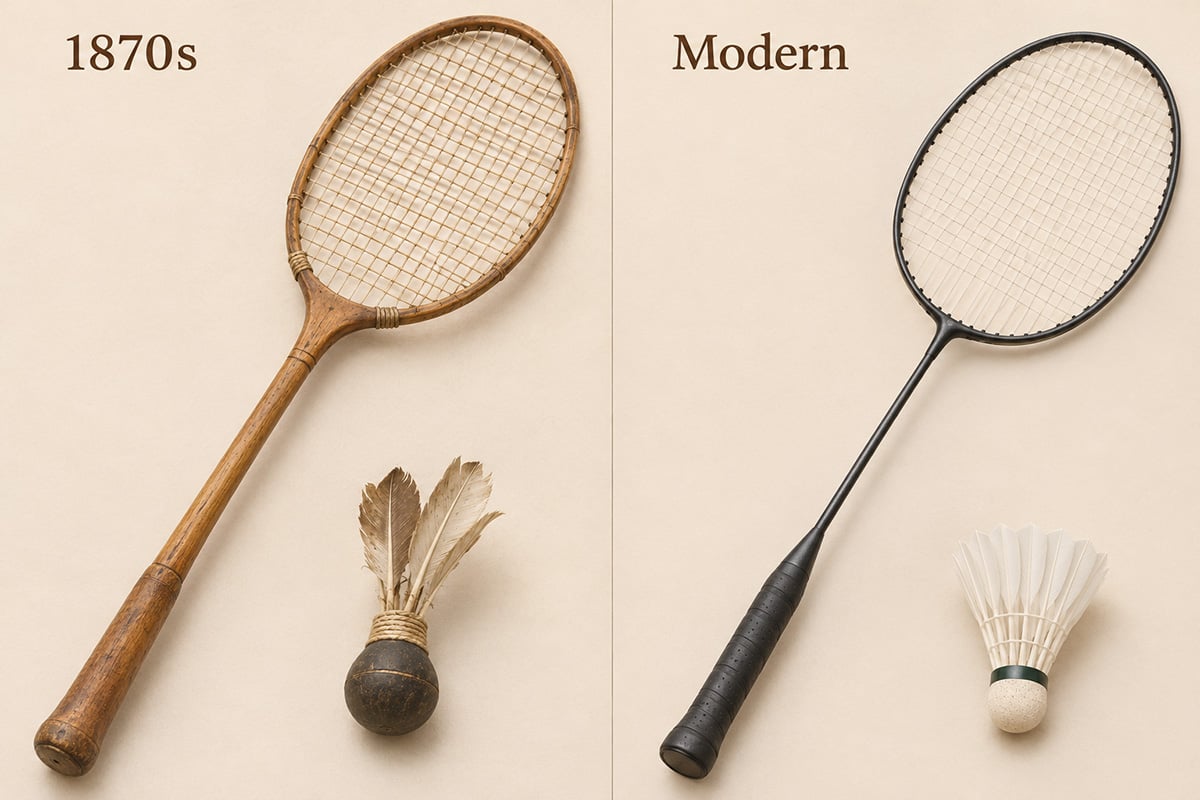
Why it is called badminton, not Poona
The name comes from Badminton House, the Duke of Beaufort's country seat in Gloucestershire. Historians agree on that much. The trouble starts with the popular story.
The popular version: officers back from India showed "Poona" at a garden party at Badminton House in 1873, and guests started calling it "the Badminton game".
What the documents show:
- The word was already in print in England ten years earlier. A December 1863 Cornhill Magazine article, "Life in a Country House", described badminton as battledore and shuttlecock played "with sides, across a string suspended some five feet from the ground."
- The rule sets sent from India to The Field newspaper in 1873 already used the name. One was headed "Badminton Rules, Simla, as adopted at Murree". Another was Major Forbes' "Handbook of Badminton" from Calcutta. So the British in India were calling it badminton in the same year the party supposedly renamed it.
- In October 1873, The Field's editor noted that his questions about the game's origin had drawn no reply from Badminton House.
- Not everyone liked the name. A reader's letter in November 1873 suggested calling it "Ladies' Tennis" instead.
The National Badminton Museum in England goes further. It thinks the game took shape at Badminton House around 1863 and that army officers carried it to India. The 1911 Encyclopaedia Britannica, on the other hand, says the game was played in India before it reached England around 1873.
My reading: both places have a real claim. England gave the game its name. British India gave it written rules, regular play and the nickname "Poona". Pune's part in the story is strong enough without the garden party.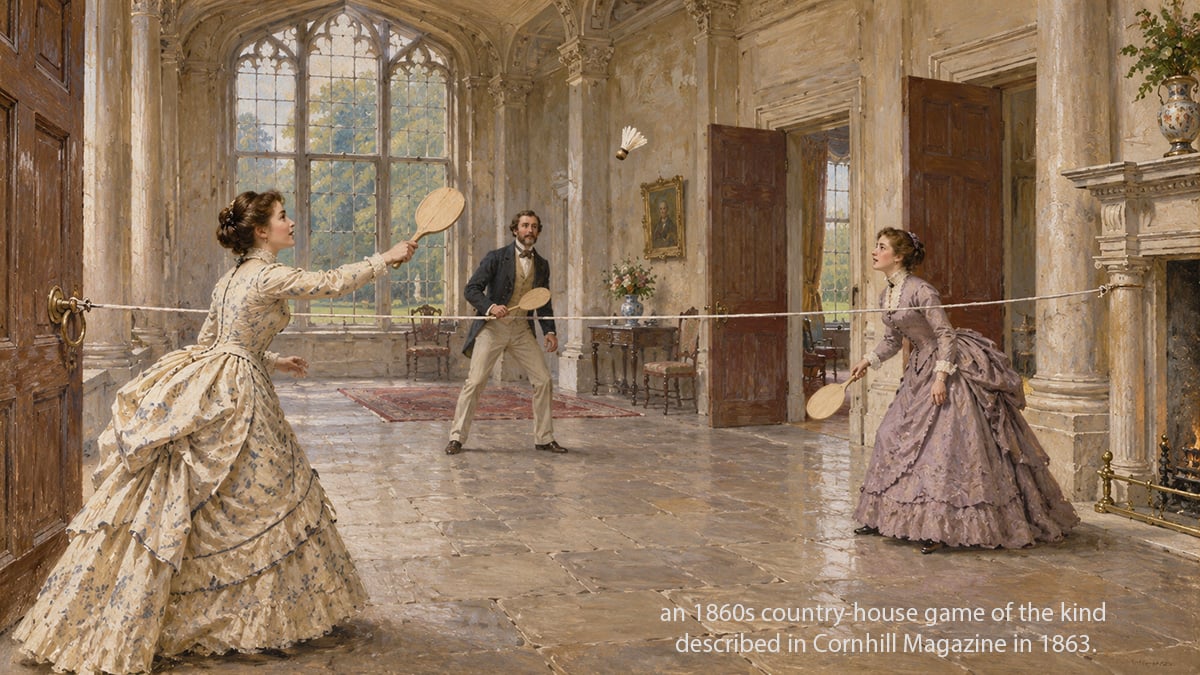
The first written rules: Poona 1873, and the Karachi question
The year 1873 is when written badminton rules show up in the record, and in more than one place.
- Poona, 1873: the standard history says the first rules were drawn up here. England then played under these India rules until 1887.
- Satara, 10 July 1873: George William Vidal of the Indian Civil Service is said to have played the first game in Western India at Satara, about 110 km from Pune. He helped frame the 1873 laws and later served as Secretary and Treasurer of the Badminton Association in England (1899 to 1906).
- Calcutta, 1873: Major Henry Twiston Forbes' "Handbook of Badminton, with Rules for Playing the Game" ran to about 3,000 words with three diagrams. The National Badminton Museum calls it probably the earliest known set of rules.
- Nagpore and Simla/Murree, 1873: two more sets printed in The Field. The Nagpore court was 30 x 15 ft. The Simla rules, as used at Murree, had 21 rules and a 39 x 20 ft court.
What about the 1877 Karachi rules?
Many websites say the "first attempt at rules" was made in Karachi in 1877. We could not find a primary record of a separate 1877 Karachi code. The documented Karachi link runs through one man:
- J.H.E. Hart first played badminton in Karachi in 1874.
- In 1876 he revised a set of rules written three years earlier by Lieutenant H.O. Selby.
- Back in England, Hart revised them again in 1887, and with Bagnel Wild in 1890.
- Hart's rules became the basis of the Badminton Association's rules in 1893.
Our conclusion: the "1877 Karachi" date is probably a garbled version of the Hart and Selby story. Karachi mattered, but because of who learned the game there.
Two more claims you will see. One is that informal rules were written in 1867. The other is that the Poona rules were drafted at the Khadki (Kirkee) ammunition factory. We found no primary source for either, so treat them as tradition, not fact.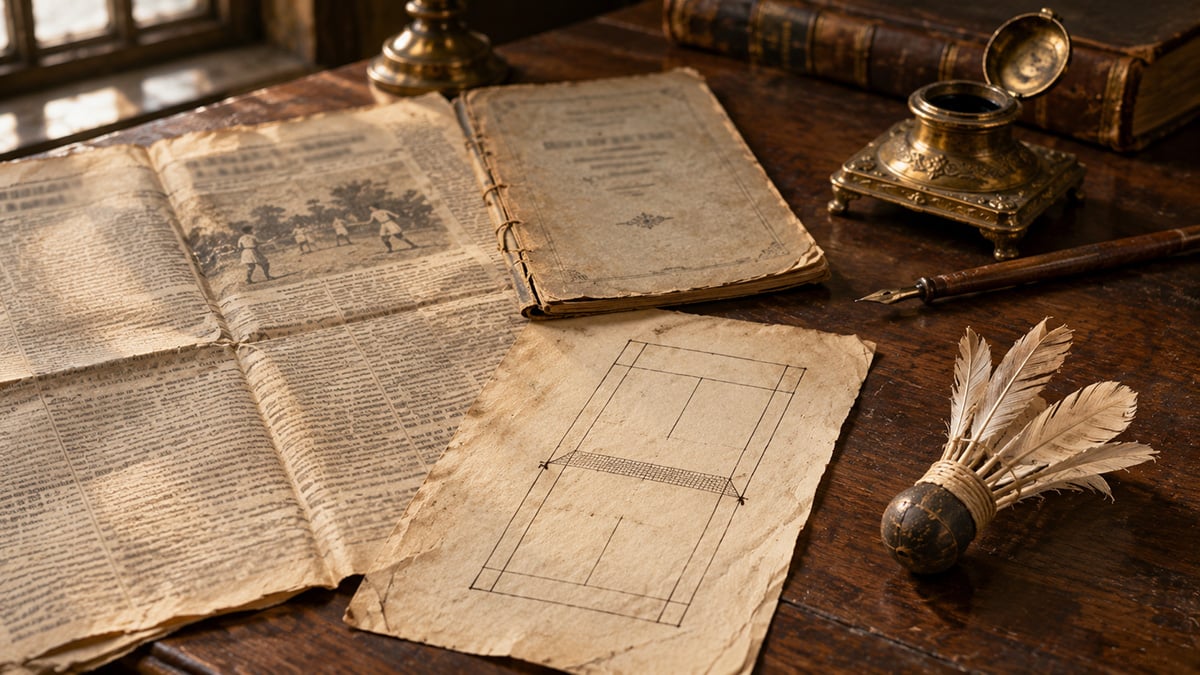
The hourglass court: two explanations
Old diagrams show a court that pinches in at the net, like an hourglass. Badminton England switched to rectangular courts in 1901. Why the pinch? There are two competing explanations.
- The doorway theory (National Badminton Museum): the North Hall at Badminton House measures 44 x 20 ft, exactly the size of a modern court. Two big doors on the side wall open inward. The museum believes players squeezed the middle of the court to keep clear of the doors, so the court was only 16 ft (4.9 m) wide at the net.
- The net post theory (badminton historian Jacobs, worldbadminton.com): in the 1873 rules, the net posts sat inside the side lines (2½ ft inside, in the Murree rules) so guy ropes could hold them up. That left "nicks" at the middle of the court. He doubts there was ever a court with truly tapering side lines.
Both explanations can be partly true. Either way, the hourglass was a practical fix, not a deliberate design.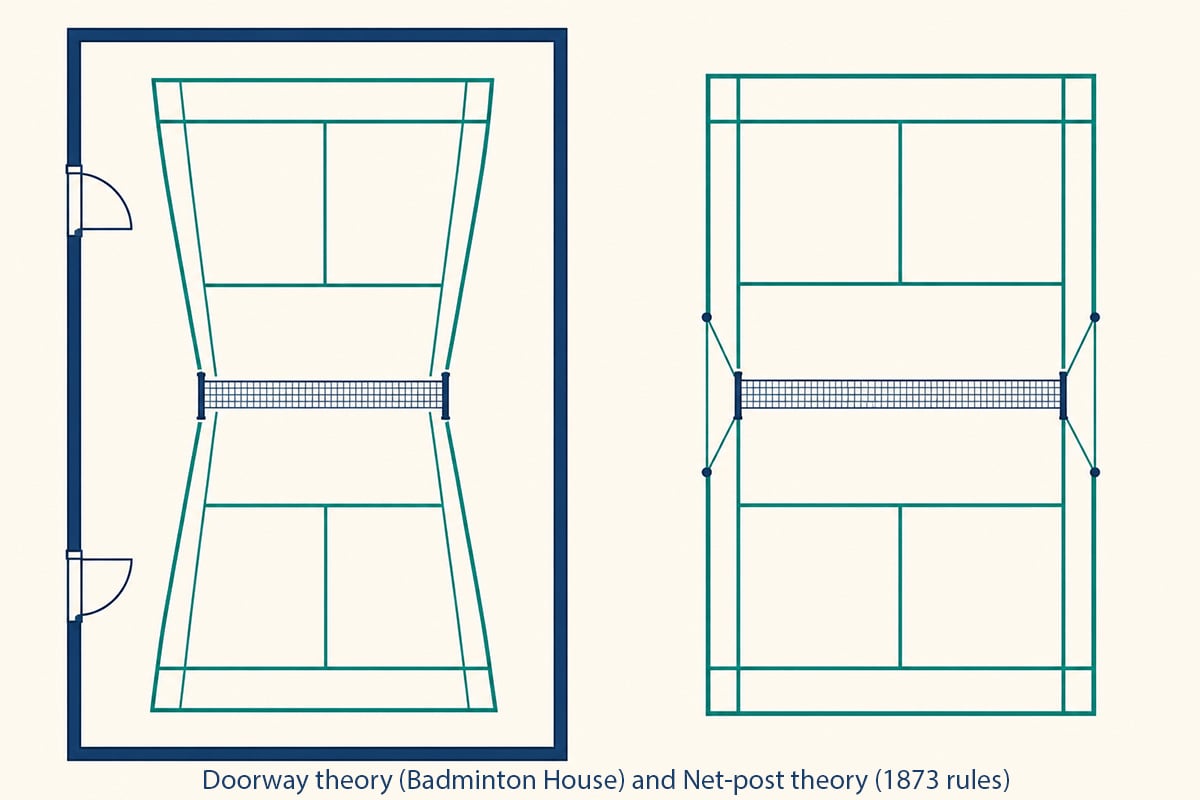
Shuttles and rackets, then and now
Shuttlecocks
- 1870s: a heavy shuttle, about 1 oz, with a rubber-covered body. Players sometimes added lead for outdoor play in wind.
- Late 1800s to early 1900s: "barrel" shuttles with chicken feathers. They broke easily, and makers switched to goose wing feathers, which proved much stronger.
- 1930s: film studies of shuttles in flight, from 1934, showed the feathers should all come from the same wing of the goose. By 1936, one English maker, RSL, was producing 40,000 cork and goose feather shuttles a week.
- Today: 16 feathers set in a cork base for competitive play. Nylon shuttles took over practice and casual games because they last longer.
Choosing between the two today comes down to where and how often you play. Feather shuttles fly truer indoors. Nylon makes more sense for beginners and regular club sessions. You can compare both types on our shuttlecocks page.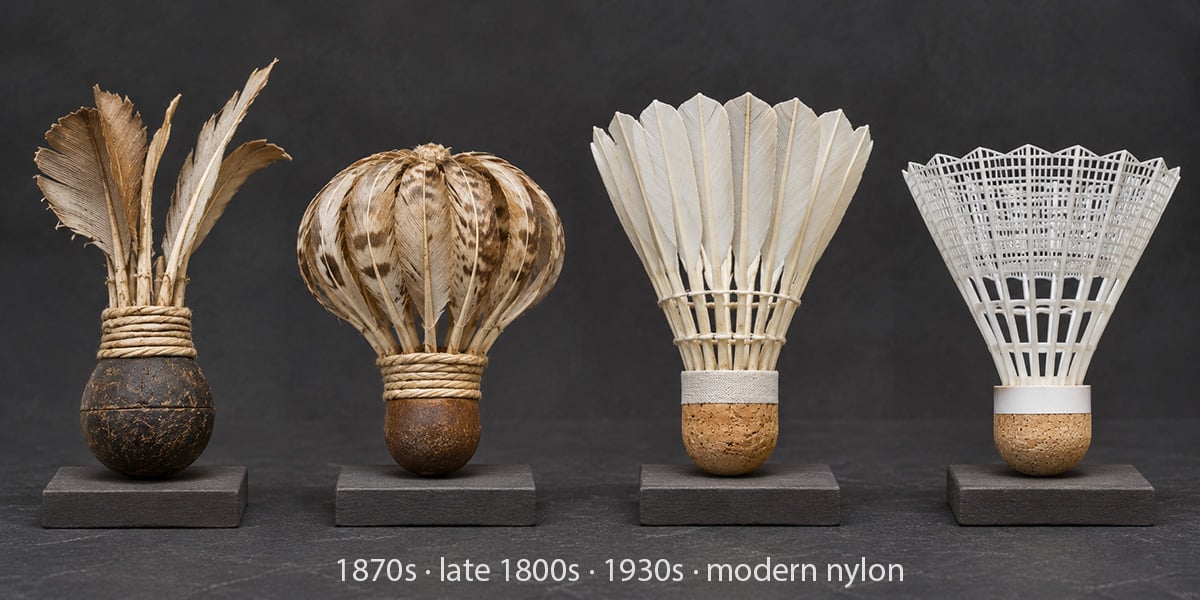
Rackets and strings
The 1870s battledore was a wooden racket about 76 cm long, a bit like a small tennis racket, strung with natural gut. Modern rackets are carbon graphite, no longer than 68 cm under the Laws, and most weigh 80 to 90 g. Browse current models in badminton rackets, our Yonex badminton rackets range, or Li-Ning.
Gut has mostly given way to thin synthetic strings, which hold tension longer and cost less. The string and tension you pick change how the racket feels as much as the frame does. See our badminton strings range.
Courts and shoes
In the 1870s the game was mostly played outdoors on grass. Today it is played indoors on wooden or synthetic courts, with fast lunges and sudden stops that the lawn game never asked for. That is why proper non-marking court shoes matter more now than any other piece of kit except the racket. Compare options in our badminton shoes range.
From India to England: Folkestone, Bath and the BAE
- 1875: officers back from India had started a badminton club in Folkestone.
- 1877: the Bath Badminton Club, usually called the first dedicated badminton club, was formed.
- 1887: J.H.E. Hart of the Bath club rewrote the rules. Until then England had played under the India rules.
- 13 September 1893: the Badminton Association of England was launched at a house called "Dunbar", 6 Waverley Grove, Portsmouth, and published the rules.
- 1899: the first All England Championships, with doubles events only. Singles were added in 1900.
Myths worth correcting
Myth 1: "British officers invented badminton in Poona"
The accurate version: shuttlecock games are centuries old across Asia and Europe. The modern net game grew up among the British in India in the mid-1800s, and Poona was one of its best-known centres. The exact origin is still unclear, and an English museum argues for Badminton House instead.
Myth 2: "The Duke of Beaufort renamed Poona at an 1873 garden party"
The name "badminton" was in print in 1863 and was being used in India by 1873. We found no contemporary record of the garden party.
Myth 3: "Poona wrote the only early rules"
In 1873, rule sets came out of Calcutta, Nagpore and Simla/Murree as well as the Poona region. Pune's place in the history is real, but it was one centre among several.
Myth 4: "Poona was played with a wool ball"
That is ball badminton, a different sport from Thanjavur. It shared the nickname, which is where the mix-up comes from.
Myth 5: "The hourglass court was a deliberate design"
Both explanations, inward-opening doors and net posts set inside the lines, describe a practical workaround.
Pune's badminton legacy today
The city never stopped playing.
- Nandu Natekar (born in Sangli in 1933, died in Pune in 2021) was the first Indian to win an international badminton title, at the 1956 Selangor International in Kuala Lumpur. He received the first Arjuna Award in 1961 and was president of the Maharashtra Badminton Association from 1990 to 1994.
- October 2008: the Shree Shiv Chhatrapati Sports Complex in Balewadi hosted badminton at the Commonwealth Youth Games (13 to 17 October) and then the BWF World Junior Championships (29 October to 2 November).
- Saina Nehwal won the girls' singles at both events in Pune. The World Junior title made her the first Indian to win it.
If you play in Pune, we deliver across the city, from Wakad and Hinjewadi to Kothrud and Pimpri Chinchwad. See our sports shop in Pune page.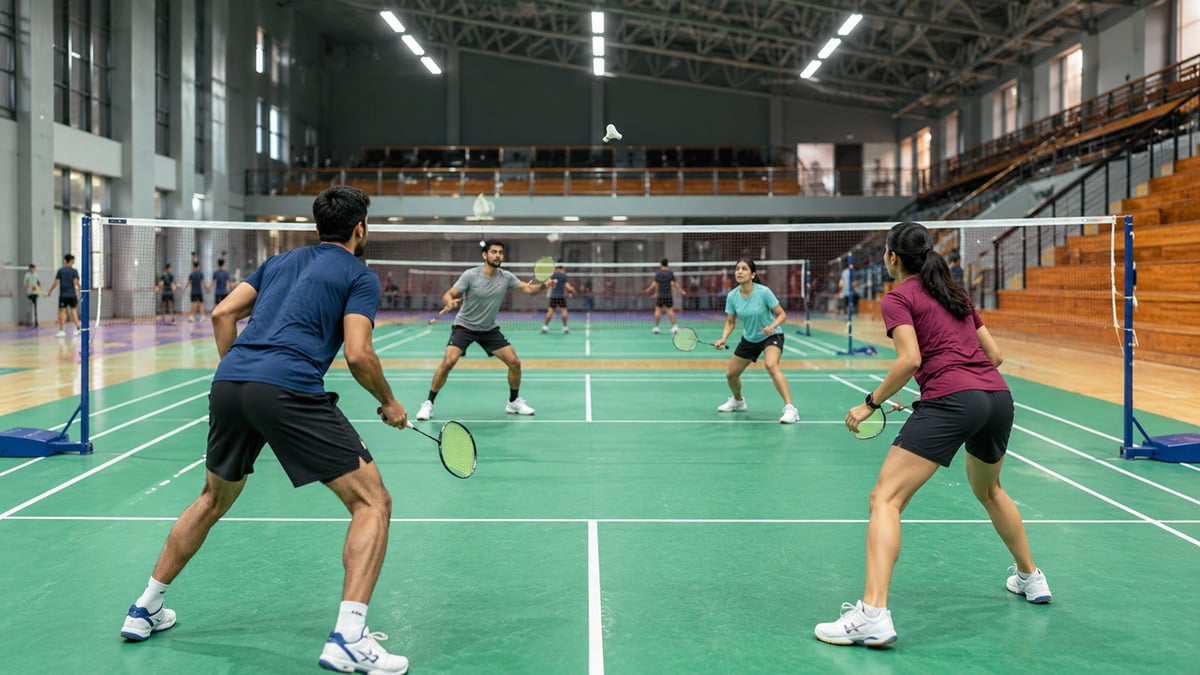
From Poona to Olympic podiums
- 1936: India joined the International Badminton Federation, two years after it was founded.
- 1980: Prakash Padukone became the first Indian to win the All England Championships.
- 2001: Pullela Gopichand won the All England.
- 2012: Saina Nehwal won bronze in London, India's first Olympic badminton medal.
- 2016 to 2021: PV Sindhu won Olympic silver in Rio (2016), the World Championship in 2019, and bronze at the Tokyo Games.
- 2022: India's men won the Thomas Cup.
One more twist. From 4 January 2027, the Badminton World Federation moves from 21-point games to 15-point games, with extra points at 14-all. The 1875 players would recognise the target. They wouldn't recognise rally scoring, though, since in their day only the server could score.
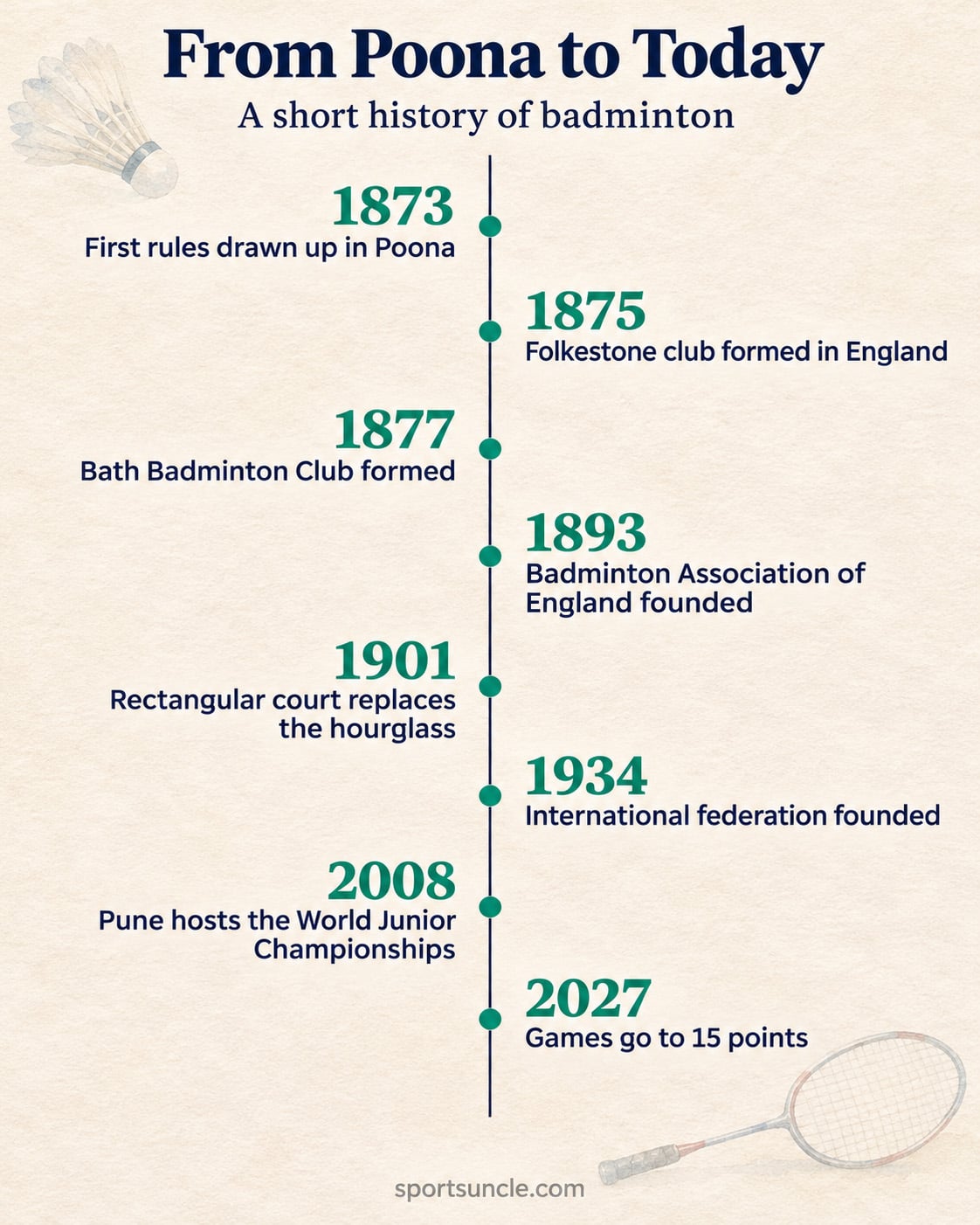
Timeline: badminton from Poona to today
| Year | What happened |
|---|---|
| 1856 | Ball badminton played in Thanjavur (a separate sport, also nicknamed "Poona") |
| 1863 | Cornhill Magazine describes badminton played across a string in an English country house |
| 1860s to 1870s | British civil servants and officers play badminton across India. It gets the nickname "Poona" |
| 1873 | First rules drawn up in Poona. Calcutta, Nagpore and Simla/Murree rule sets printed in The Field |
| 1874 | J.H.E. Hart first plays badminton in Karachi |
| 1875 | Folkestone club formed by returning officers. Badminton gets an entry in the Encyclopaedia Britannica |
| 1876 | Hart revises Lieutenant H.O. Selby's 1873 rules |
| 1877 | Bath Badminton Club formed. Bishop of Madras protests "Sunday badminton" |
| 1887 | Hart revises the rules in Bath. England stops using the India rules |
| 1893 | Badminton Association of England launched in Portsmouth (13 September) |
| 1899 | First All England Championships |
| 1901 | Rectangular court replaces the hourglass court |
| 1934 | International Badminton Federation founded (now BWF) |
| 1936 | India joins the IBF |
| 1956 | Nandu Natekar wins the Selangor International, India's first international title |
| 1980 | Prakash Padukone wins the All England |
| 1992 | Badminton becomes an Olympic sport (Barcelona) |
| 2008 | Pune hosts the BWF World Junior Championships. Saina Nehwal wins the girls' singles |
| 2027 | BWF switches to 15-point games (from 4 January) |
Frequently asked questions
Why was badminton called Poona?
Because it was especially popular in the British garrison town of Poona (now Pune), where the first rules are said to have been drawn up in 1873. "Poona" and "Poonah" were nicknames used in British India.
Was badminton invented in Pune?
Not exactly. Shuttlecock games are much older, and nobody knows precisely where the net version began. Pune's verified claim is that it was a major early centre of the game and is credited with the first written rules in 1873.
Why is the game called badminton?
It is named after Badminton House, the Duke of Beaufort's estate in Gloucestershire, England. The name was in print by 1863. Why or how the estate's name attached to the game is still unknown.
When were the first badminton rules written?
In 1873. That year rule sets appeared from the Poona region, Calcutta, Nagpore and Simla/Murree. The Calcutta handbook by Major Forbes is probably the oldest set that still exists in the record.
Were there 1877 Karachi rules?
We could not verify a separate 1877 Karachi code. What is documented: J.H.E. Hart learned the game in Karachi in 1874 and revised Lieutenant Selby's rules in 1876. Hart's later revisions became the basis of the 1893 Badminton Association rules.
Was the early court really hourglass-shaped?
Courts were narrower at the net until 1901. One theory blames the inward-opening doors of the hall at Badminton House. Another says net posts were set inside the side lines to hold the guy ropes.
What were early shuttlecocks made of?
In the 1870s they were heavy, about 1 oz, with a rubber-covered body. Later shuttles used chicken feathers, which were replaced by stronger goose feathers. Modern feather shuttles use 16 goose or duck feathers in a cork base.
Is Poona the same as ball badminton?
No. Ball badminton is a separate sport from Thanjavur, played with a woollen ball. It was also nicknamed "Poona" early on, which is why the two get confused.
What is changing in badminton scoring in 2027?
From 4 January 2027, BWF matches are best of three games to 15 points, replacing 21. At 14-all, a player needs a two-point lead, and at 20-all, the next point wins.
Sources
- Wikipedia: Badminton (history section)
- National Badminton Museum: Badminton House
- National Badminton Museum: The game of badminton in 1863
- Badminton Museum: Early ball badminton and shuttle badminton in India
- World Badminton: Origins of the sport (1873 rules in The Field)
- World Badminton: Origins of the sport (the name)
- World Badminton: 1875 Encyclopaedia Britannica rules
- National Badminton Museum: barrel shuttlecocks
- Badminton Museum: History of Reinforced Shuttlecocks Ltd
- BWF: Members approve 3x15 scoring system
- Olympics.com: History of badminton in India
- Wikipedia: 2008 BWF World Junior Championships
- Wikipedia: Nandu Natekar
The game has come a long way from rubber-covered shuttles on cantonment lawns. If you are kitting out for today's version, start with badminton at SportsUncle, or pick up a badminton kit bag to carry it all.
Leave a Reply
Your email address cannot be published. Required fields are marked*
Latest Articles from Blog
No comments