

Loading cart...
 My Account
 Track Order
 Sports Guide
-
Price Range
-
Brands
-
Stock Status
-16%

₹770 ₹645
-53%
₹830 ₹390
-64%


₹1,099 ₹395
-26%
₹670 ₹495
-27%
₹1,320 ₹970
-34%
₹690 ₹455
-20%
₹865 ₹695
-32%
₹1,285 ₹875
-55%
₹700 ₹315
-24%


₹535 ₹405
-45%


₹1,190 ₹650
-17%
₹1,055 ₹875
-24%
-31%
₹790 ₹545
-25%

₹590 ₹445
-33%

₹900 ₹599
-26%

Showing 1 to 17 of 17 (1 Pages)
How to choose a badminton string
Three things decide how a string plays: gauge (thickness), the four performance properties (repulsion, control, durability, hitting sound), and the tension you string it at. We've covered all three in depth in our badminton string buying guide and the physics of string tension article. The short version: thinner strings give more power and break faster, higher tension is more control with a smaller sweet spot (not more power), and you can't optimise for repulsion and durability at the same time.
If you're new to choosing strings, read the buying guide first, then come back to pick a specific string from this page.
Pick a string by playing style
For smashing and attacking play
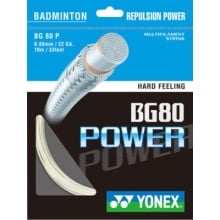
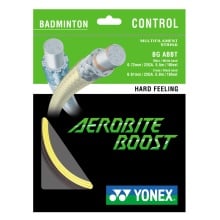
Yonex BG80 Power, BG66 Ultimax, Exbolt 63, Aerosonic, and Aerobite Boost are the five we recommend most. All thin gauge (0.61–0.68mm), all high repulsion, all built to return energy hard. BG80 Power is the most durable of the group; Aerosonic is the sharpest but breaks fastest. Most attacking club players settle on BG66 Ultimax or Exbolt 63 as a working compromise.
For control and accuracy
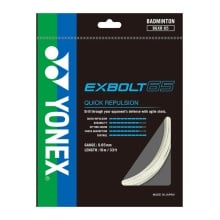
Yonex Nanogy 95 (where stocked) and Exbolt 65 sit at the head of this category. Both have textured surfaces that grip the shuttle slightly longer, which is what "control" actually means in string spec. Doubles players who play tight net shots and deceptive flicks benefit most from these.
For durability and long sessions
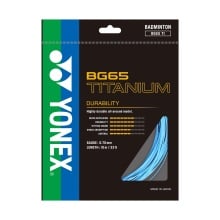
Yonex BG65 is the world's most-sold badminton string for a reason. 0.70mm gauge, hits everything decently, hard to break. BG65 Ti is the titanium-coated version, slightly more durable still. If you string less than once a month and don't want to think about strings, this is the answer. Apacs Lethal 66 is the same idea at a lower price point.
For all-round play
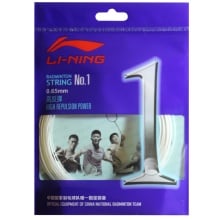
Yonex Exbolt 65 is the best general-purpose string Yonex makes right now — balanced across all four properties, holds tension well, and works for most styles. Li-Ning No. 1 fills the same role at a slightly lower price.
Strings by brand
Yonex
Yonex dominates this category and for good reason. The BG series (BG65, BG66, BG80, BG85), the Nanogy series (95, 98, 99), the Exbolt series (63, 65, 68), and the specialist strings (Aerosonic, Aerobite, Aerobite Boost) cover every playing style and every price point from ₹400 to ₹1,500 per packet. Every Yonex string we ship carries the genuine-product hologram and is sourced through authorised channels. Counterfeit Yonex strings are common in the Indian market — check the packaging carefully if you ever buy from a non-specialist seller.
Li-Ning
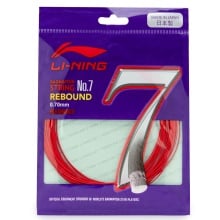
Li-Ning's string range is smaller than Yonex's but technically competitive. No. 1 is the all-rounder, No. 7 Boost is the high-repulsion option, and the NS95 is the durability pick. Pricing typically runs 15–25% below the Yonex equivalent for similar specs.
Apacs
Apacs Lethal 63 and Lethal 66 are the two we sell most often from this brand. Both are genuine performance strings at notably lower prices than Yonex's premium range. Quality is consistent enough for serious club play, though touring-level players generally prefer Yonex for tension hold over a long match.
Pro stringing service before dispatch
Most online retailers in India ship strings as packets and leave you to find a local stringer. We do it differently. If you're buying a string with a racket from our badminton rackets section, we'll fit the string at our Meerut workshop before the racket ships — tell us your tension at checkout and the racket arrives ready to play. We string from 20 lbs up to the manufacturer's rated maximum on the frame, no higher (stringing above the rated tension cracks frames and voids warranty, so we don't do it regardless of how the customer asks).
If you're buying strings on their own to take to your local stringer, that's fine too — we ship the packet sealed and original.
Common questions
How often should I restring my racket?
Standard rule: restring as many times per year as you play per week. Three sessions a week, three restrings a year. Strings lose tension steadily from the day they're fitted, even when they don't break — a racket strung six months ago feels noticeably softer than the same racket strung yesterday, regardless of what the tension reads. If you've been playing on the same string for over a year, restring before your next match. You'll notice the difference immediately.
What tension should I string at?
Beginner: 20 to 22 lbs. Club player: 24 to 26 lbs. Strong club or district player: 26 to 28 lbs. State and above: 28 lbs or higher. We've explained the reasoning behind these numbers in detail in our physics of string tension article — including why "more tension = more power" is the most common myth in badminton, and why stringing at 30 lbs without the technique to back it up usually leads to a softer hit and a sore elbow.
Will any string fit my racket?
Almost. Every string on this page works on every standard badminton racket. The thing to check is your racket's rated maximum tension — printed on the shaft, also listed on the product page if you bought from us. Don't string above that limit. If your racket is rated to 24 lbs, putting Aerosonic at 28 lbs on it will stretch the frame even if the string survives.
How do I know the string is original?
Yonex strings carry a hologram on the back of the packet. Li-Ning strings carry a verification number on the inner label. We don't ship a string where the brand provides authentication and it doesn't pass. If you receive a packet that looks tampered with, send us a photo and we'll replace it without argument.
What is the cheapest decent badminton string?
On this page, Apacs Lethal 66 and Yonex BG65 are the two cheapest strings we'd actually stand behind. Both sit around the ₹300 mark. Anything cheaper than that on the open market is usually unbranded nylon — it'll work, but it'll feel dead, lose tension within days, and snap unpredictably. Restringing labour costs the same regardless of which string is in the racket, so spending an extra ₹100 on the string itself almost always works out cheaper over a year.
Do you sell badminton stringing machines?
Not currently. Stringing machines are specialist equipment and we'd rather you use a trained stringer (ours, or a local one) than learn on a ₹15,000 manual machine and pull frames out of square. If you're seriously thinking about buying one, contact us first — we can usually advise on which machines are actually worth the money in the Indian market.
What if my string breaks during play?
Restring the racket before your next session. Don't try to repair a single broken main — the remaining strings are now under uneven tension and the frame is taking lateral stress it wasn't designed for. We've covered the full restring-vs-repair question in our racket string repair guide if you want the longer version.