

Loading cart...
 My Account
 Track Order
 Sports Guide
What is the best badminton string tension?
For most players, higher string tension does not equal more power. Beginners should use 18-21 lbs to maximise the sweet spot and utilise the trampoline effect for free power. Intermediate players thrive at 22-25 lbs for a balance of power and control. Only advanced players with perfect technique should string at 26-30+ lbs (the plank feel) for pinpoint accuracy, as it offers zero power assistance and increases the risk of arm injury.
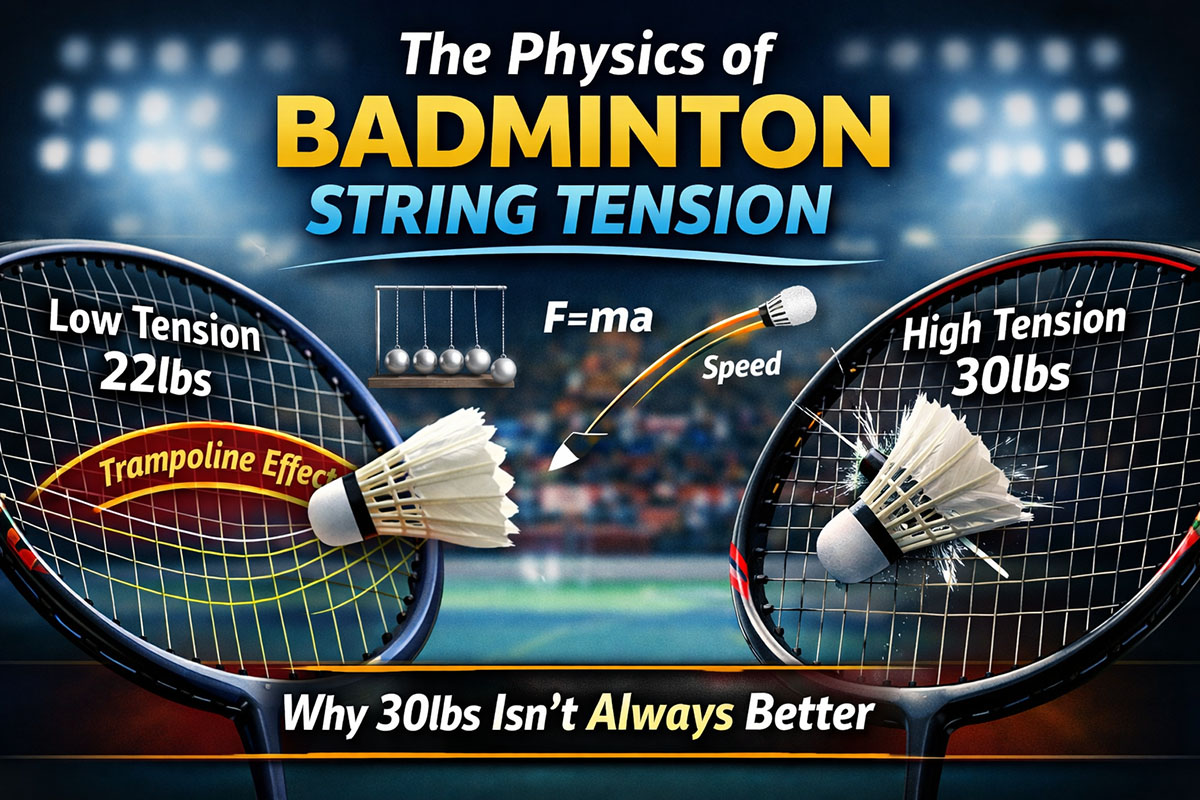
The difference between winning and losing a crucial rally often comes down to milliseconds and millimetres. Your badminton string choice is the engine of your racket, transforming it from a simple frame into a precision instrument.
While many players obsess over the racket frame, the string bed tension has a more dramatic impact on power, control, and overall performance. A common myth among beginners is "Higher Tension = More Power." The laws of physics say the opposite.
This comprehensive guide will walk you through the science of badminton strings, from the "Trampoline Effect" of 24lbs that generates free power, to the "Plank Feel" of 30lbs that demands professional technique, helping you choose the perfect setup for your game.
1. The Physics: The "Trampoline Effect" vs. "The Plank"
To understand tension, you must understand Dwell Time (how long the shuttle stays on the strings) and Repulsion. Increasing tension increases pressure on the frame, but it fundamentally changes how energy is transferred to the shuttle.
Low Tension (20-24 lbs): The Trampoline Effect
At lower tension, the strings act like a trampoline. Upon impact, the strings stretch significantly, increasing dwell time.
- The Science: The strings absorb the shuttle's energy, stretch, and then snap back to their original position. This "snap-back" contributes to the trampoline effect.
- The Benefit: This provides free power for players who don't have extremely fast swing speeds. It is forgiving, effortless, and easy on the arm.
High Tension (28-30+ lbs): The Plank Feel
At higher tension, the string bed is stiff. It does not stretch. The shuttle bounces off the surface instantly, reducing dwell time.
- The Science: There is no "energy assistance" from the strings. The power must come entirely from your wrist snap and swing speed.
- The Benefit: Since the shuttle leaves the bed instantly, the direction is 100% accurate to the racket angle. There is no "wobble," giving you pinpoint control. However, this requires precise technique to avoid mishits.
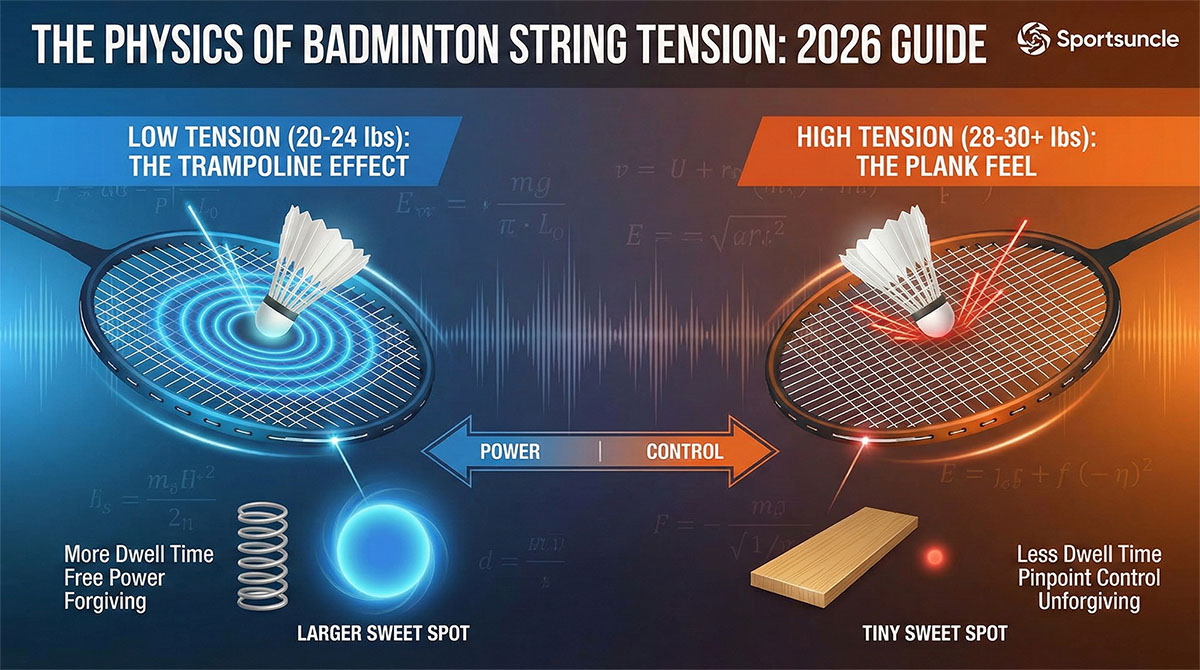
2. Visualizing the Sweet Spot: 24lbs vs. 30lbs
One of the biggest trade-offs in tension physics is the size of the effective hitting area (Sweet Spot). As tension increases, your margin for error disappears.
| Feature | Lower Tension (20-24 lbs) | Higher Tension (26-30+ lbs) |
|---|---|---|
| Sweet Spot Size | Large (Forgiving) | Tiny (Unforgiving) |
| Power Source | Strings aid the power (Trampoline) | Player generates the power (Technique) |
| Control | Lower (Shuttle "wobbles") | Maximum (Instant feedback) |
| Vibration | Low (Strings absorb shock) | High (Shock travels to arm) |
| Sound | Dull "Thud" | High-pitched "Ping" |
Pro Tip: If you mishit a shuttle at 30lbs, the shock travels directly to your elbow because the stiff strings didn't absorb it. This is a leading cause of Tennis Elbow
3. Types of Badminton Strings
Understanding the three main categories of badminton strings helps you prioritise what matters most for your playing style.
Power Strings (Thin Gauge)
Power-oriented strings prioritize maximum repulsion. They typically feature thinner gauges (0.61mm-0.68mm).
- How they work: The reduced material allows for greater string bed deformation, storing more energy that gets released as shuttle speed.
- Top Picks: Yonex BG80 (0.68mm) is the gold standard for attackers. Yonex BG66 Ultimax (0.66mm) offers even higher repulsion but breaks faster. Woods Metaflex Pro is a great value alternative.
Control Strings (Textured)
Control strings emphasize precision and shuttle "bite."
- How they work: They often feature textured surfaces or rough coatings that increase friction with the shuttle. This allows for more spin and precise net play.
- Top Picks: Yonex NBG95 and Yonex Aerobite Boost (Hybrid). These are excellent for players who rely on deception rather than raw power.
Durability Strings (Thick Gauge)
Durability strings prioritise longevity. They are thicker (0.70mm+) and designed to withstand frequent mishits.
- How they work: The thicker core resists notching and breakage. While they feel "stiffer," they are the most economical choice.
- Top Picks: Yonex BG65 is the world's most popular string for a reason—it is a workhorse. Victor VBS70 offers a good balance of durability and slight power.
4. String Gauge Guide: Thickness Matters
You cannot talk about tension without mentioning Gauge (Thickness). The thickness of the string changes how the tension feels.
| Gauge Type | Thickness | Characteristics |
|---|---|---|
| Thin Strings | 0.61 - 0.68mm | The "Ferrari" of setups. Incredible repulsion and crisp sound. Pros use these for the ultimate "feel," often at higher tensions, though durability is lower. |
| Medium Strings | 0.69 - 0.72mm | The sweet spot. Yonex BG65 (0.70mm) is the standard here. Good power, great life. Performs well at all tensions. |
| Thick Strings | 0.73mm+ | Very durable but can feel numb. Best for beginners who often hit the frame. Lower tensions help bring some "life" back to these strings. |
5. Recommended Tension by Skill Level
Selecting the optimal badminton string tension requires an honest evaluation of your playing characteristics. Use this chart as your baseline.
| Player Level | Recommended Tension | Why? |
|---|---|---|
| Beginner | 18 - 21 lbs | Maximises the sweet spot to help with off-centre hits. Adds "free power" to clears. |
| Intermediate | 22 - 25 lbs | The "Sweet Spot" for most club players. Good balance of power for smashes and control for net play. |
| Advanced | 26 - 29 lbs | Sacrifices power assistance for pinpoint accuracy. Requires perfect timing and wrist snap. |
| Professional | 30+ lbs | Zero margin for error. Used by elite players who need instant feedback for deceptive shots. |
Note: Using the same tension on different rackets or strings can produce different results. Experimentation is key to finding your preference.
Adjustments for Playing Conditions
- Plastic Shuttles: Drop your tension by 2-3 lbs. Plastic shuttles are heavier and feel "dead" on the string bed; looser strings bring life back to the shot.
- Humid Weather: Nylon strings absorb moisture and lose tension. String 1 lb tighter in summer/monsoon.
- Cold Weather: Strings become brittle. String 1 lb looser to prevent breakage.
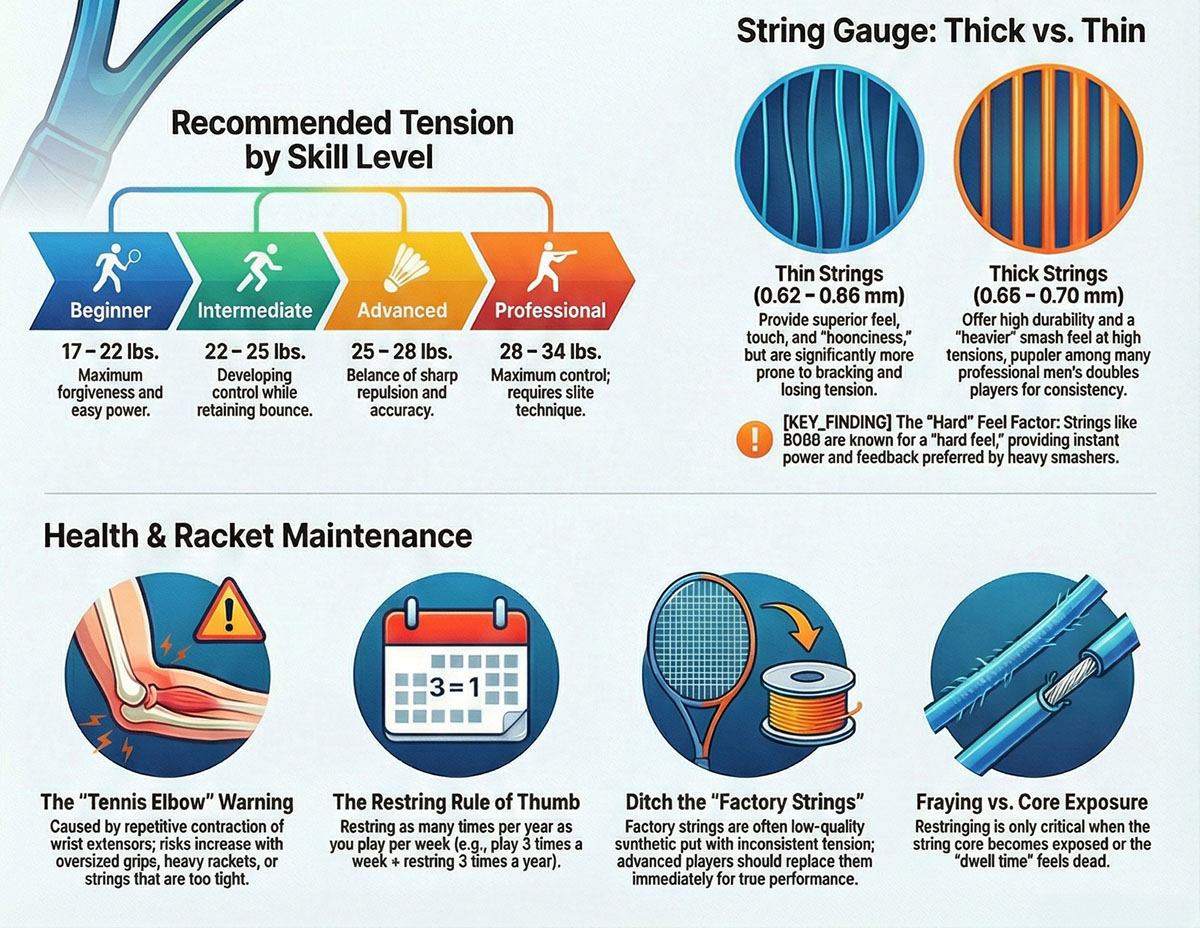
6. Maintenance: When to Restring?
Many recreational players wait until a string snaps to replace it. This is a mistake. Strings are like tyres; they lose grip and performance long before they "pop." In fact, attentive players may notice a decline in shot quality or responsiveness before the strings actually break, as subtle changes in tension and elasticity become apparent during play.
Signs Your Strings are "Dead":
- Loss of Tension: High-quality strings lose 10-15% of tension within the first month. If your racket sounds like a dull "thud" instead of a crisp "ping," the elasticity is gone.
- Notching: Look at the intersections where strings cross. If the strings are cutting halfway into each other, they are about to break.
- Fraying: Visible fuzzy fibers on the string surface indicate the outer coating has worn off.
Rule of Thumb: If you play 3 times a week, you should restring at least 3 times a year.
Conclusion
Choosing the correct badminton string tension is about finding the balance between Power (Trampoline) and Control (Plank).
- Start Lower: If you are struggling to clear the shuttle to the back boundary, drop your tension.
- Go Thinner: If you want more "feeling" and a better sound, switch to a 0.68mm string like BG80.
- Don't Copy Pros: Playing with 32lbs tension without professional technique will likely result in a shoulder injury, not a faster smash.
For advanced players, using electronic machines can help achieve more precise and consistent string tension, especially when fine-tuning your setup.
Your perfect string setup awaits—start with the recommendations in this guide and refine based on your playing experience. Investing in the right string and tension setup provides the best value for your money, offering optimal performance and durability.