

Loading cart...
 My Account
 Track Order
 Sports Guide
-
Price Range
-
Brands
-
Stock Status
-35%
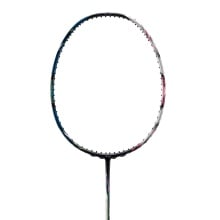
₹26,990 ₹17,490
-36%
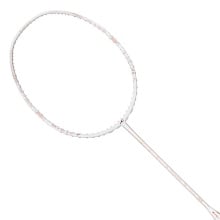


₹9,390 ₹5,990
-39%
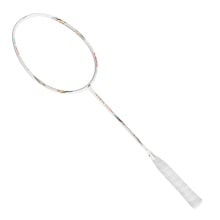


₹5,590 ₹3,390
-40%
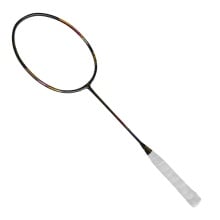
₹13,290 ₹7,975
-32%
-32%
₹11,025 ₹7,450
-39%
-45%
₹4,955 ₹2,745
-40%
₹4,955 ₹2,995
-25%
₹16,900 ₹12,675
-25%
₹17,400 ₹12,995
-30%
₹18,900 ₹13,250
-44%


₹2,750 ₹1,530
-35%
₹14,335 ₹9,250
-40%
₹13,990 ₹8,375
-34%
₹13,990 ₹9,290
-37%
₹13,420 ₹8,499
-32%
₹5,140 ₹3,495
-31%
₹9,190 ₹6,299
-36%
₹6,290 ₹3,995
-45%
₹27,990 ₹15,495
-33%
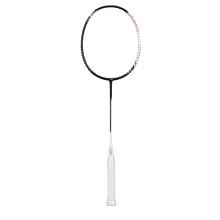
₹14,990 ₹9,975
-40%
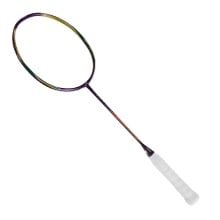
₹13,990 ₹8,375
-40%
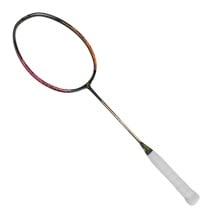
₹13,990 ₹8,375
-40%
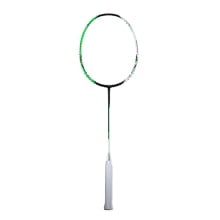
₹8,990 ₹5,399
-40%


₹4,990 ₹2,999
-45%
₹4,890 ₹2,675
-45%


₹3,390 ₹1,875
How to choose a badminton racket
Weight, balance and shaft flex matter more than the brand or the price. Get those three right for your style, and you'll play better with a ₹2,500 racket than with a ₹15,000 one that doesn't suit you. The rest of this page is a working buyer's reference, written by people who play.
If you'd rather skip the reading, our badminton racket selector takes 30 seconds — answer a few questions about your style, level and budget, and it shortlists the right rackets from our catalogue.
Racket weight (the U system)
Badminton rackets are graded on the unstrung weight of the frame. A lower number means a heavier racket.
- 2U (90–94g): Heavy and slow to swing, but generates serious smash power — a niche choice. Most players don't need this.
- 3U (85–89g): Standard for singles players who hit hard from the back. Lee Zii Jia, Viktor Axelsen and most top male singles players use 3U.
- 4U (80–84g): The default. About half the rackets sold worldwide are 4U. Suits doubles, suits singles, suits beginners moving past their first racket.
- 5U (75–79g): Light and quick. Good for front-court doubles, juniors, and anyone who has had wrist or elbow trouble.
If you don't know what to pick, get a 4U. You won't be wrong. For a deeper read on this, see our 3U vs 4U vs 5U weight guide.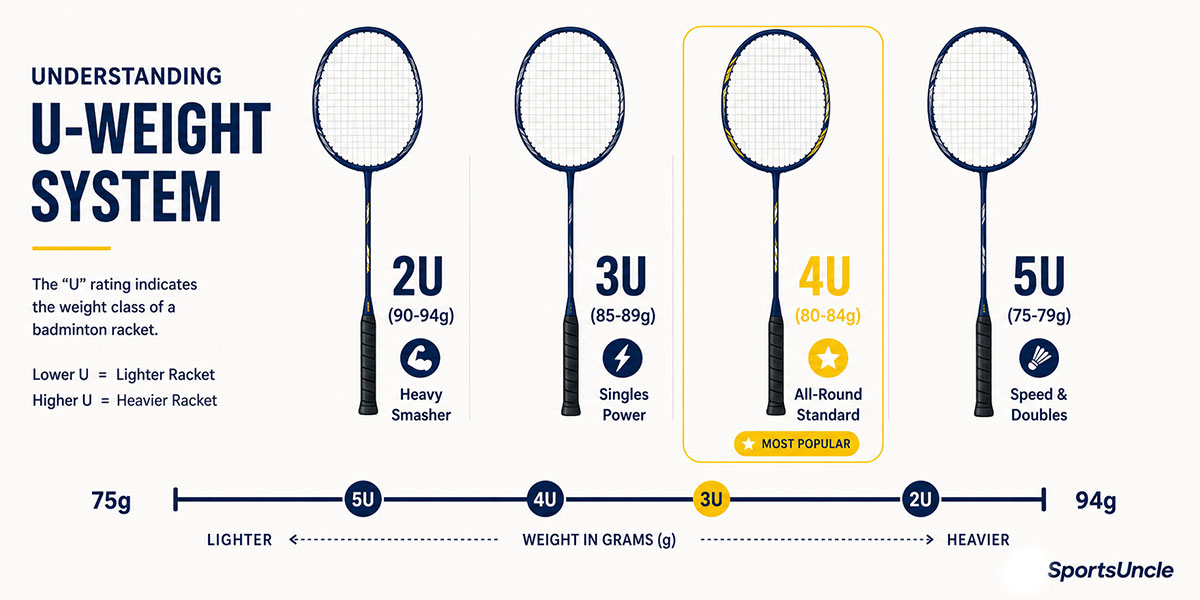
Balance
Pick up the racket. If the head feels heavier than the handle, it is head-heavy. If the handle feels heavier, it is head-light. If neither end seems to win, it is even-balanced. The balance point sits around 285–295mm from the butt cap for head-light rackets, 295–300mm for even balance, and 300mm or higher for head-heavy.
Head-heavy rackets like the Yonex Astrox, Li-Ning Axforce and Victor Thruster series help you hit steeper smashes with less effort. Head-light rackets like the Yonex Nanoflare and Li-Ning Bladex are quicker through fast doubles drives. Even-balance rackets like the Yonex Arcsaber and Li-Ning Tectonic work for players who drift between attacking and defending.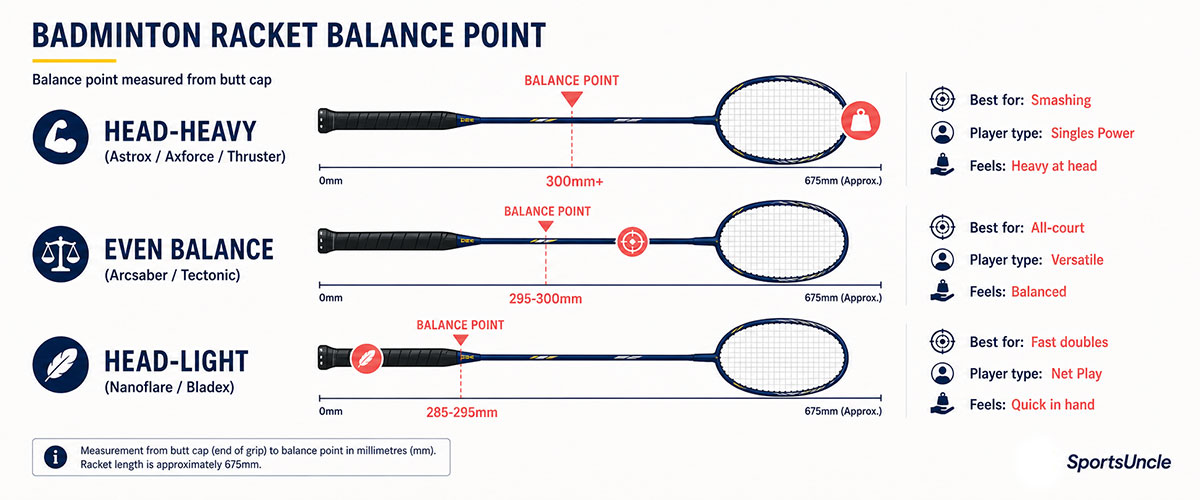
Shaft flex
A stiff shaft returns faster, but only if your swing speed is high enough to load it. Most players overestimate their swing speed. If you're below national-tournament level, stick to medium flex. A flexible shaft will feel softer at the wrist and forgive a slow arm. We've covered this in detail in our stiff vs flexible shafts guide.
String tension
Beginner: 20 to 22 lbs. Club player: 24 to 26 lbs. Strong club or district player: 26 to 28 lbs. State and above: 28 lbs or higher. Higher tension isn't "more power". It's more control with a smaller sweet spot, and it shortens the life of the strings. We string every racket on this page in our own workshop before dispatch, so you can specify your tension at checkout.
Which brand should you buy
Honest brand-by-brand advice from running this shop since 2016, not a sales pitch.
Yonex
Yonex is the default. Best after-sales in India, widest range, easy to find replacement strings and grips for. The Astrox series is the smasher's racket, Nanoflare is the speed line, Arcsaber is the all-rounder. The Astrox 99 Play 3rd Gen and the Arcsaber 11 Play are the two we recommend most often to intermediate players.
Li-Ning
Li-Ning has caught up to Yonex on technology and often beats Yonex on price for the same spec. The Axforce series is the closest equivalent to Astrox. Windstorm is fast and light. The Bladex line has become very popular through 2025-26 for doubles. If you don't have brand loyalty, Li-Ning often gives more racket per rupee.
Victor
Victor has the smallest range of the big three but the strongest reputation among serious doubles players. The Thruster Ryuga is one of the best smashing rackets at any price, and the Auraspeed line is very good for fast hands at the net.
Apacs and Woods
Both Apacs and Woods offer 38 lbs tension support and full Japanese graphite at prices the big three can't match below ₹3,000. The Apacs Z-Ziggler and Woods Trimach 2 punch well above their weight class. Worth a look if your budget is tight and your standards are not.
Why buy from SportsUncle
We aren't a general marketplace. We've been running this shop since 2016.
- Every Yonex and Li-Ning racket on this page is checked against the brand's authentication system before it ships. The Indian market has a counterfeit problem, and we take it seriously.
- Stringing happens in our own workshop. Tell us your tension and string preference at checkout, and the racket arrives ready to play.
- If a racket arrives broken in transit, we replace it if you provide a real unpacking video. This is a standing policy, not a case-by-case favour.
- Our team plays. The person on the other end of a call or WhatsApp message has hit shuttles with most of these rackets and will give you an honest opinion based on your style, not on which racket has the highest margin.
If you'd like to read what other buyers think, see our customer reviews page.
Common questions
How do I know the racket I receive is original?
Yonex rackets carry a scratch code on the side of the frame that you can verify on Yonex India's website. Li-Ning rackets carry a hologram with a verification number. We don't ship a racket where the brand provides these and the verification fails. If you receive a racket and the check doesn't pass, we replace it without argument.
Should I buy strung or unstrung?
Buy unstrung if you have a clear preference for tension and string type. Buy strung if you don't. Factory stringing on most rackets is around 22 to 24 lbs, which works fine for beginners and casual club players. We can string at higher tension before dispatch at no extra cost on most models.
What is the best badminton racket for beginners under ₹2,000?
The Yonex Nanoray Light 18i, Li-Ning XP 70 IV and Apacs Honor 30 are the three we recommend most often. All are 4U full graphite frames, all string up to 24 to 26 lbs, all are forgiving of poor technique. We cover this in detail in our badminton rackets under ₹3,000 guide.
Yonex or Li-Ning, which one?
Same money, both fine. Yonex has better resale value and more visible customer support. Li-Ning often has better specs at the same price. If you can't decide, look at which racket your usual playing partners use, since you'll probably want to compare yours to theirs.
What is the best badminton racket in 2026?
For most players: the Yonex Astrox 99 Play 3rd Gen for power, the Yonex Nanoflare 1000 Play for speed, and the Woods Trimach 2 for value. We update our picks every six months. The current full list lives in our top 10 badminton rackets under ₹5,000 guide and our badminton rackets under ₹3,000 guide. For a recommendation matched to your specific style, level and budget, use our badminton racket selector.
Do you ship outside India?
Yes. International rates apply and vary by destination. Check the checkout to see the shipping charges.