

Loading cart...
 My Account
 Track Order
 Sports Guide
The weight of your badminton racket can make or break your game. Whether you are crushing smashes from the backcourt or snapping fast drives at the net, the "U" number on your racket shaft dictates your speed and power.
Yet, many players are confused. Is a 3U racket too heavy for a beginner? Is a 5U racket too weak for a smash?
In this guide, we demystify the "U" Weight System. We compare 3U, 4U, and 5U side-by-side to help you find the perfect match for your playing style.
1. Decoding the "U" System
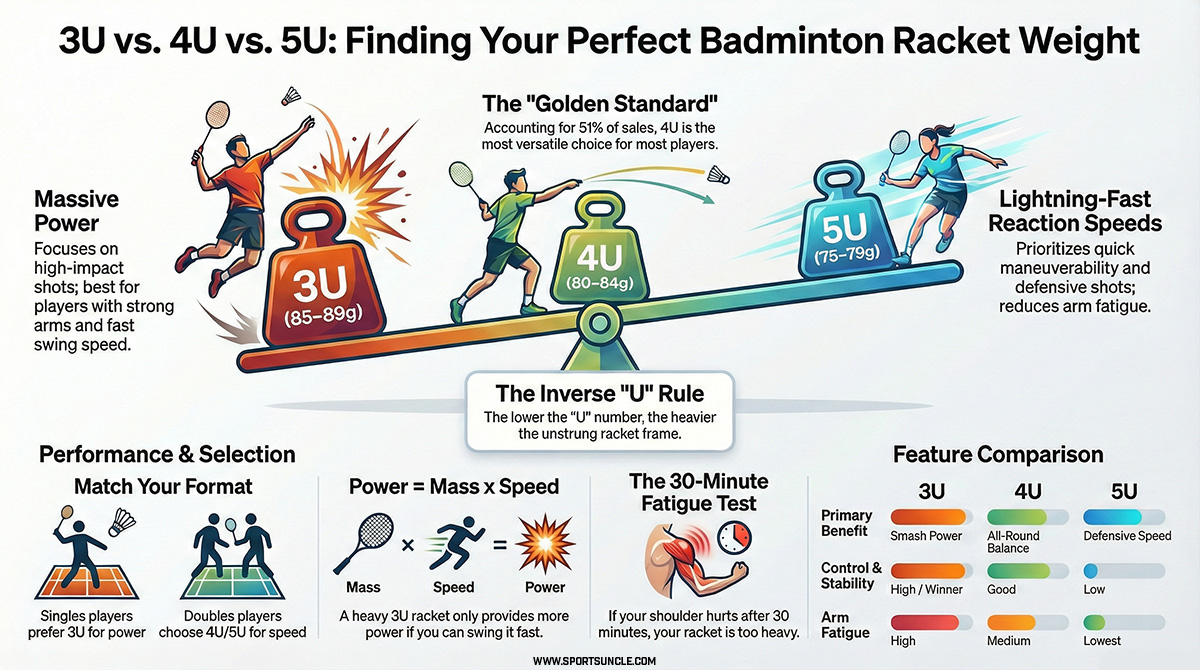
In modern badminton, the "U" stands for the weight of the unstrung frame.
The Rule: The lower the number, the heavier the racket.
- The Reality: Once you add strings (~4g), grip (~10g), and sweat, the actual playing weight is much higher.
| Category | Weight (Unstrung) | Common Use |
|---|---|---|
| 2U | 90g - 94g | Old School / Training (Rare) |
| 3U | 85g - 89g | Singles / Power Attack |
| 4U | 80g - 84g | Doubles / All-Round (Most Popular) |
| 5U | 75g - 79g | Speed / Defense / Injury Rehab |
| F / 6U | < 73g | Ultra-Light / Junior |
2. 3U Rackets: The Power Champions
Weight: 85g - 89.9g
Best For: Singles Players, Rear-Court Smashers.
The 3U is the heavyweight of the modern game. It carries more mass, which means it has more momentum.
Browse 3U badminton rackets on Sportsuncle - heavy, powerful smash
Pros & Cons
| Pros | Cons |
|---|---|
| ✅ Massive Power: The heavy head carries momentum through the shuttle, creating a heavier smash. | ❌ Slow Defence: Harder to lift quickly for net kills or smash blocks. |
| ✅ Stability: The frame doesn't twist on off-centre hits. Solid feel. | ❌ Fatigue: Tires out the arm and shoulder quickly. |
| ✅ Control: Heavier mass provides a steady, "planted" feel. | ❌ High Skill Cap: Requires strong wrists and perfect technique. |
Pro Insight: Most elite Men's Singles players (like Lee Zii Jia) use 3U rackets because they need the shuttle to travel deep into the opponent's court effortlessly.
3. 4U Rackets: The "Golden Standard"
Weight: 80g - 84.9g
Best For: Doubles Players, Intermediate Players, Fast Attackers.
This is the most popular category in the world (approx. 51% of market sales). It balances speed and power perfectly. Wide range of 4U Badminton rackets.
Why 4U is the "Sweet Spot"
Manoeuvrability: It is light enough to react to fast drives in Doubles.
Power: It is heavy enough to generate a decent smash without fluttering.
Versatility: Suitable for both Singles and Doubles.
4. 5U Rackets: The Speed Demons
Weight: 75g - 79.9g
Best For: Front-Court Doubles, Defensive Players, Juniors, Injury Recovery.
If you want lightning-fast reactions, 5U is your weapon.
Browse our lightweight 5U badminton rackets.Pros & Cons
| Pros | Cons |
|---|---|
| ✅ Insane Speed: You can switch from forehand to backhand instantly. | ❌ Low Power: Physics works against you. Less mass = Less smash momentum. |
| ✅ Injury Safe: Very little stress on the elbow or shoulder. | ❌ Technique Dependent: You must use a fast "whip" action to generate power. |
| ✅ Net Play: Unbeatable for interceptions and tap-kills. | ❌ Durability: Ultra-light frames are often more fragile during clashes. |

5. Head-to-Head: Which Weight Wins?
We compared the three categories across key performance metrics.
| Feature | 3U (Heavy) | 4U (Medium) | 5U (Light) |
|---|---|---|---|
| Smash Power | Winner | Medium | Low |
| Defense Speed | Slow | Good | Winner |
| Control/Stability | Winner | Good | Low |
| Arm Fatigue | High | Medium | Lowest |
| Best Format | Singles | Doubles | Front-Court Doubles |
6. How to Choose the Right Weight (Step-by-Step)
Don't just buy what the pros use. Use this checklist to find your match.
Step 1: Analyse Your Format
Singles: Go for 3U. You have more time to set up big shots.
Doubles: Go for 4U. The game is too fast for heavy rackets.
Mixed Front Court: Go for 5U. You need interception speed, not power.
Step 2: Assess Your Strength
Strong Wrists / Gym Goer: You can handle 3U.
Average Strength: Stick to 4U.
Recovering from Injury / Junior: Stick to 5U.
Step 3: The "Fatigue Test"
If your shoulder hurts after 30 minutes of play, your racket is too heavy. Drop down one weight class (e.g., 3U to 4U).
7. Common Myths Busted
Myth: "Heavier rackets are always more powerful."
Truth: Power = Mass x Speed. If a 3U racket is too heavy for you to swing fast, you will actually generate less power than you would with a 4U racket.
Myth: "5U rackets are for beginners."
Truth: Many elite Women's Doubles players use 5U/F rackets for net interceptions. It is a strategic choice, not a skill level choice.
Myth: "Pros only use 3U."
Truth: Many top Doubles pros (like the "Minions" from Indonesia) use 4U rackets for speed.
Conclusion: Which U is for You?
Choose 3U if: You are a singles player who loves to smash and has strong wrists.
Choose 4U if: You play doubles, want a "do-it-all" racket, or aren't sure where to start. (Safest Bet).
Choose 5U if: You are a front-court specialist, a junior, or suffering from tennis elbow.
Ready to pick your weapon? Check out our list of the Top 10 Badminton Rackets Under ₹3000 to see excellent 4U and 5U options available right now.
Frequently Asked Questions
Can I use different racket weights for different types of matches?
Yes, many advanced players maintain multiple rackets with different weights for specific situations. For example, using a 3U racket for singles competitions where power is crucial, and switching to a 4U for doubles tournaments where speed is paramount. However, this approach requires significant practice with each weight to maintain consistency in timing and feel. Most recreational players benefit more from mastering one optimal weight rather than switching between multiple options.
How does racket balance affect the feel of 3U vs 4U vs 5U rackets?
Balance point significantly influences how weight feels during play, sometimes more than the actual mass difference. A head-heavy 4U racket may feel more demanding than an even-balanced 3U racket despite being lighter overall. Headlight configurations can make heavier rackets feel more manoeuvrable, while head-heavy setups increase the swing weight sensation. When comparing different weights, consider the complete specifications, including balance and stiffness, rather than weight alone.
Is it normal to experience arm fatigue when switching to a heavier racket?
Yes, transitioning to a heavier racket commonly causes initial fatigue as your muscles adapt to the increased load. This adaptation period typically lasts 2-4 weeks with regular play. However, persistent fatigue or joint pain beyond this period may suggest that the weight is inappropriate for your current physical condition. Gradual adaptation through shorter initial sessions can help ease the transition.
Do professional players prefer specific weights for tournaments?
Professional preferences vary significantly based on playing style, format, and individual biomechanics. While many singles professionals favour 3U rackets for power, top doubles players frequently use 4U for enhanced speed. Some professionals also customise their rackets with lead tape or specific string tensions to achieve their preferred total weight and balance, making their nominal weight category less meaningful than their final playing specifications.
How much does string tension affect the performance differences between these weights?
String tension has minimal impact on the fundamental weight characteristics but can influence how the weight feels during play. Higher tensions generally make any racket feel stiffer and more responsive, potentially making heavier rackets feel more manageable. However, tension changes cannot compensate for inappropriate weight selection. A 3U racket strung at high tension will still be heavier and less manoeuvrable than a 4U racket, regardless of string setup. Focus on selecting the right weight first, then optimise string tension for your preferred feel and playing style.

Vijaydeep Saini
Smashing sentences and shuttlecocks with equal precision. A wordsmith on the court and an athlete at the keyboard, serving aces and anecdotes. Pen in hand, racket ready—let’s play.
Related Products
-70%

₹1,299 ₹395
-54%
₹850 ₹395
-59%
₹799 ₹325
-52%
₹2,499 ₹1,195
Leave a Reply
Your email address cannot be published. Required fields are marked*
Latest Articles from Blog
No comments