

Loading cart...
 My Account
 Track Order
 Sports Guide
Buying a badminton racket in India means navigating hundreds of options across brands, price points, and confusing technical labels — 3U, 4U, head-heavy, stiff shaft, G4, G5. This page answers every real question buyers ask, from what these specs actually mean to the best rackets under ₹2000, ₹3000, and ₹5000 for Indian players. No filler, no brand promotion — just straight answers so you can make the right choice for your game.
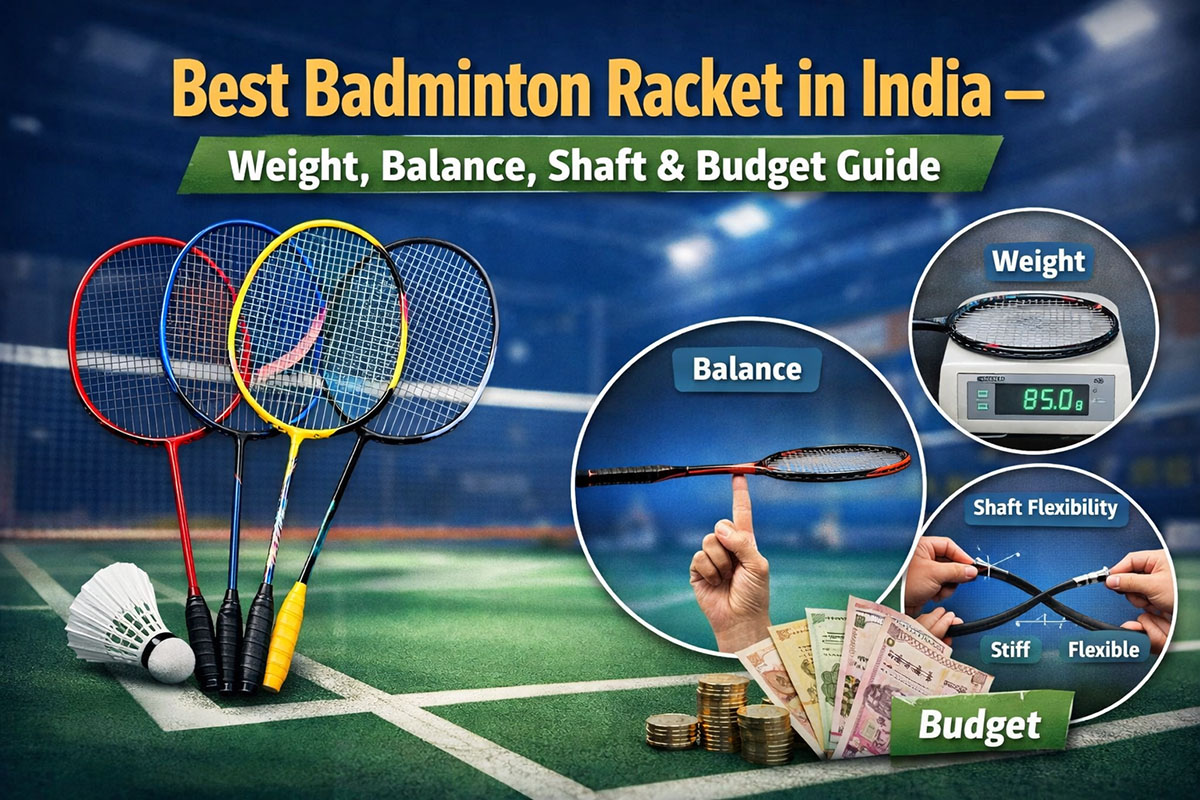
Understanding Racket Specs — Weight, Balance, and Stiffness
This section covers the technical labels you will see on every racket. Understanding these before buying will save you from choosing something that fights your game rather than supports it.
What do 3U, 4U, and 5U mean in badminton rackets?
These are Yonex weight classifications. The U stands for the weight range of the unstrung racket:
- 3U: 85–89 grams
- 4U: 80–84 grams
- 5U: 75–79 grams
The higher the number, the lighter the racket. Most club and intermediate players use 4U — it offers a balance of power and manoeuvrability. 5U is common in faster doubles play. 3U is less common today and mostly seen in older or budget models. Complete guide to badminton racket weight 3U vs 4U vs 5U
Is 4U or 5U better for fast rallies?
5U is better for fast rallies. The lighter weight means quicker swing recovery, faster reaction on defence, and less arm fatigue during long exchanges. In doubles, especially, where drives and blocks happen in quick succession, a 5U gives you an edge in response time.
That said, 4U is not a disadvantage — players with stronger wrists and faster swings often prefer the slightly heavier feel for controlled smashes. If your game involves a lot of net play and quick exchanges, lean toward 5U.
Does heavier racket weight actually increase smash power?
Marginally — but not in the way most players expect. More mass creates more momentum at impact, which in theory means harder smashes. However, swing speed contributes far more to shuttle speed than racket weight does. A lighter racket swung faster will generate equal or greater power than a heavier racket swung slowly.
Most professional players — including power smashers — use 4U rackets, not 3U. If you are choosing a heavier racket specifically for smash power, the gains will be minimal unless your swing technique and speed are already strong.
Will a stiff shaft reduce power if my technique is average?
Yes, it will. A stiff shaft is designed to transfer energy directly to the shuttle with minimal flex. To generate power from a stiff shaft, you need a fast, clean swing that loads and releases the shaft correctly at impact. If your swing speed is average or your timing is inconsistent, the shaft never flexes enough to add that whip-through effect — and you end up hitting flatter, weaker shots.
Stiff shafts reward advanced players with fast swing mechanics. For club players or those still developing technique, a medium-flex shaft will produce more consistent power. Want to know more about stiff vs flexible shafts?
Will a flexible shaft help me generate power easily?
Yes, especially for players with moderate swing speeds. A flexible shaft bends slightly during the downswing and snaps back through at impact, adding extra pace to the shuttlecock even when your swing is not particularly fast. This is why most beginner and intermediate rackets use medium- to flexible-shafts — they are more forgiving and help generate power without demanding perfect timing.
The tradeoff is control. At higher playing levels, a flexible shaft can make it harder to place shots precisely because the flex introduces a small timing variable. For most club players, though, that tradeoff is worth it.
Does frame shape affect power or control?
Yes, meaningfully. There are two common frame shapes:
- Isometric (square head): A larger, more evenly distributed string bed. The sweet spot is bigger, which means off-centre hits still travel well. Most modern rackets — particularly Yonex — use isometric frames. Better for control and consistency.
- Oval (conventional): Badminton Strings are concentrated toward the centre, creating a smaller but more precise hitting zone. Less forgiving on off-centre hits, but preferred by some advanced players who want maximum feel on every shot.
Frame thickness also matters. Thinner frames cut through the air faster, giving a quicker swing. Wider frames are slightly more aerodynamically resistant but can offer more stability on impact.
Which racket materials are most durable for doubles clashes?
This depends on your budget range. Here is an honest breakdown:
- Aluminum frames (budget rackets, typically under ₹1000) are surprisingly impact-resistant — they dent rather than crack, which makes them physically tough against clashes. However, they are heavy and lose performance quickly.
- Carbon fiber / graphite frames (mid to high-end rackets) are lighter and far superior in performance, but they can develop stress fractures or cracks from repeated hard clashes. High Modulus Graphite — used by brands like Yonex in rackets from the ₹3000 range upwards — is stiffer and more resistant to this kind of impact damage than standard graphite.
For doubles players who play aggressively near the net and experience frequent clashes, a mid-range full graphite racket (₹2500–₹4000) with a reinforced frame is the practical sweet spot between durability and performance. Avoid ultra-thin premium frames at this stage — they are optimised for performance, not impact resistance.
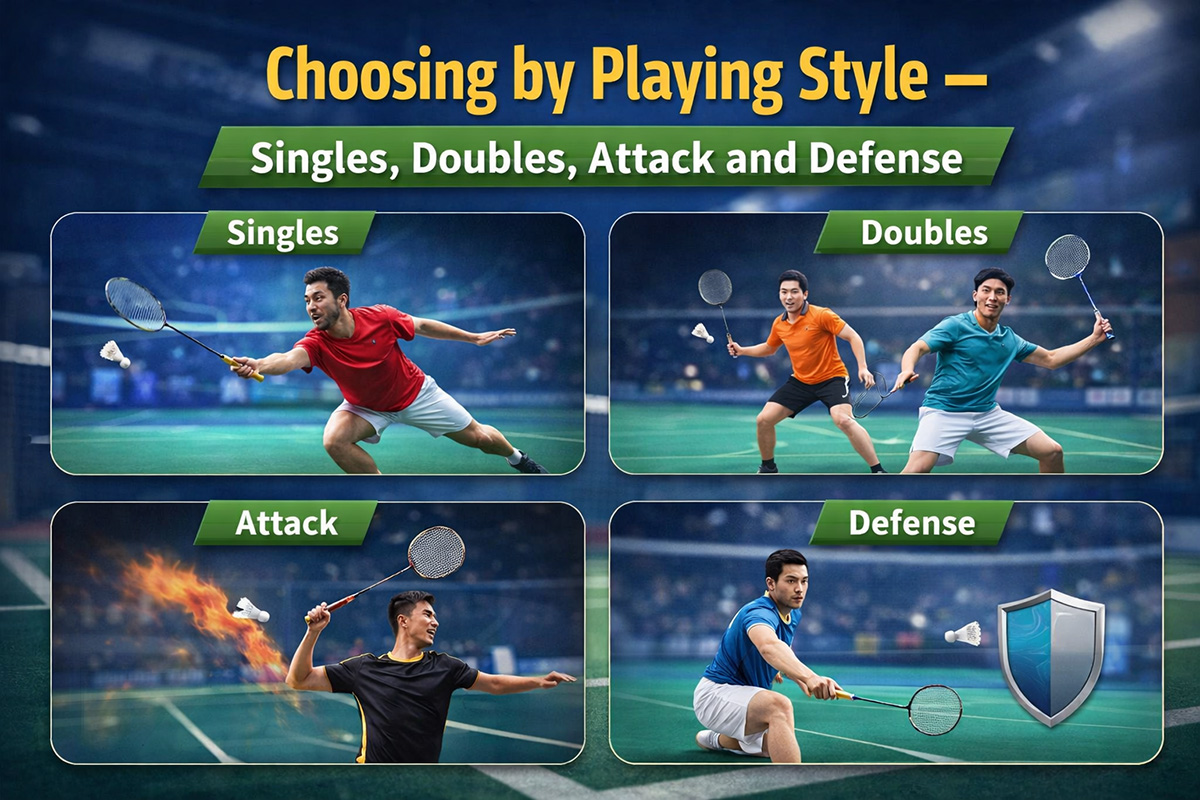
Choosing by Playing Style — Singles, Doubles, Attack and Defence
Racket specs only make sense when mapped to how you actually play. This section helps you match balance, weight, and shaft flex to your specific game.
What type of racket is best for singles vs doubles?
The demands of singles and doubles are quite different, and racket choice reflects that.
Singles involves longer rallies, more court coverage, and a heavier emphasis on smashing and clearing from the back. Singles players generally prefer head-heavy rackets with a stiffer shaft — the extra weight at the head drives the shuttle deeper and harder, which is critical when you are covering the full court alone.
Doubles are faster and more compact. Rallies are shorter, net exchanges happen quickly, and reaction time matters more than raw power. Doubles players generally prefer head-light or even-balance rackets — the lighter head makes swing recovery faster and defence easier when drives are coming at you from close range.
If you play both, an even-balance racket is the practical middle ground.
I mostly play doubles, which racket should I buy?
Look for these three things:
- Balance: Head-light or even balance for faster reaction and swing recovery
- Weight: 4U or 5U — lighter rackets reduce fatigue during fast exchanges
- Shaft: Medium to stiff — a medium shaft gives you enough flex for clears from the back, while a stiff shaft handles net drives and blocks cleanly
Avoid head-heavy rackets for doubles unless you are playing in the back court role exclusively and have a partner covering the net. For most doubles players, the speed penalty from a head-heavy racket outweighs the power benefit.
Which racket works best for fast doubles drives?
For drives — flat, fast exchanges across the net — you need a racket that swings and recovers quickly. The ideal setup:
- Head-light balance reduces the rotational weight during quick wrist-driven swings
- 5U weight gives maximum manoeuvrability
- Stiff shaft ensures the racket responds immediately without lag — a flexible shaft can feel sluggish on fast flat drives because it bends slightly before releasing
Players who specialise in mixed doubles or men's doubles drives often prefer head-light, stiff-shaft rackets precisely for this reason. Yonex Nanoflare series is a good reference point for this type of racket design.
Which racket balance is best for a defensive playing style?
Head-light is the clear answer for defensive players. When you are reacting to smashes, the racket needs to move from your ready position to the shuttle's path in a fraction of a second. A lighter head means less resistance during that quick swing — your wrist and forearm can redirect the racket faster.
Head-heavy rackets make defence noticeably harder. The extra weight at the top increases rotational inertia, slowing reaction swings. If your game involves a lot of lifting, blocking, and counter-dropping, a head-light balance will feel like a significant upgrade.
I want power but also quick defence, which balance type should I choose?
Even balance is the correct answer here, and it is the most popular balance type among all-round club players for exactly this reason. It sits between head-heavy (power) and head-light (defense), giving you a workable compromise on both ends.
You will not smash as hard as a dedicated head-heavy racket user, and you will not defend as quickly as a dedicated head-light racket user — but the difference is smaller than most people expect at club level. What you gain is a racket that does not actively fight either part of your game.
If you are playing recreational or competitive club badminton 3–4 times a week across both singles and doubles, even balance is the most practical daily choice.
Is an even-balance racket good for attacking play?
It is decent, but not ideal for pure attacking play. Even-balance rackets do not generate as much natural momentum through the hitting zone as head-heavy rackets do, which means your smash speed will depend more on your own swing speed than on the racket's weight distribution.
That said, many intermediate players using even-balance rackets hit perfectly adequate smashes — especially when combined with good technique and a moderately stiff shaft. If your game is 70% attack and 30% everything else, a head-heavy racket will serve you better. If attack is just one part of your game, even balance works fine.
Which racket is best for all-round gameplay?
An even-balance racket with a medium flex shaft and 4U weight covers the widest range of playing situations. This combination:
- Handles smashes without being sluggish
- Defends without too much head resistance
- Clears and lifts comfortably from the back court
- Suits both singles and doubles play
Most Yonex Arcsaber series rackets are designed specifically around this all-round profile. Li-Ning's Windstorm and Air Force series also target this segment. For Indian club players who switch between game formats, this is the safest starting point.
What equipment suits players with a slower swing speed?
Two things matter most here:
- Flexible or medium flex shaft — a flexi shaft generates power through its own whip action, compensating for slower swing speeds. You do not need to swing fast to get decent pace on the shuttle.
- Head-heavy balance — the extra weight at the head builds momentum even on a slower swing, which helps with clears and smashes when your arm speed is not naturally fast.
The combination of a flexible shaft and head-heavy balance is the most forgiving setup for players who are still building swing speed. Most beginner-to-intermediate rackets are designed around exactly this principle.
Which racket is easiest to use for long matches?
Lighter rackets — 4U or 5U — reduce arm and shoulder fatigue significantly over 60–90 minutes of play. The difference between a 3U and a 5U racket is only around 10 grams, which sounds negligible, but across hundreds of swings in a long match it adds up.
Beyond weight, an even-balance or head-light racket is easier to sustain over time because the arm muscles are not fighting a top-heavy swing repeatedly. Head-heavy rackets can cause noticeable fatigue in the forearm and shoulder during extended play.
What racket should a wrist-based player choose?
Wrist-based players — those who generate power and deception through snap and rotation at the wrist rather than full arm swings — benefit most from a head-heavy racket with a lighter overall weight (4U or 5U).
The weight concentrated at the head amplifies the momentum of a wrist flick, turning a small fast movement into a harder-hitting shot. A head-light racket with the same wrist flick will produce a noticeably weaker result because there is less mass generating momentum at impact.
The lighter overall weight is important because it keeps the racket manoeuvrable despite the head-heavy balance — wrist players depend on quick, tight movements, and a heavy overall racket will slow that down.
Smash, Control, and Specific Shot Performance
This section focuses on specific shots — smash, net play, defense, and backhand — and which racket characteristics directly influence each.
Which racket gives the strongest smash under ₹5000?
For the strongest smash under ₹5000, you need a head-heavy balance with a stiff or medium-stiff shaft — that combination drives the most power through impact. At this price range, full graphite rackets are available from Yonex, Li-Ning, and Victor, and all three brands offer smash-oriented options.
A few honest pointers before you decide:
- Under ₹5000, you are buying from the entry-to-mid range. Racket quality at this price is solid but not exceptional — the difference between brands at this range is smaller than marketing suggests.
- A stiff shaft at this price point will only benefit you if your swing speed is reasonably fast. If not, a medium flex will generate more actual power for your game.
- Yonex Astrox 99 Play and similar entry-level Astrox models are designed around smash performance and fall within this range.
- The strongest smash ultimately comes from swing speed and technique more than the racket itself — but a head-heavy, stiff graphite racket under ₹5000 gives you the best platform to work with.
Will a head-heavy racket slow down my defence?
Yes, noticeably — and this is one of the most important tradeoffs to understand before buying. A head-heavy racket has more mass concentrated at the top, which increases rotational inertia. When a smash comes at you and you need to react in a fraction of a second, that extra weight at the head creates resistance during the quick redirecting swing.
The effect is most pronounced during:
- Blocking fast smashes close to the body
- Quick defensive lifts from the rear corners
- Net exchanges where the racket needs to move through small, fast angles
If you play singles and spend time at the back court attacking, a head-heavy racket makes sense because defence is secondary to your power game. But if you play doubles or mixed, where smashes come from close range with little reaction time, the defensive penalty of a head-heavy racket is a real practical problem — not just a spec sheet concern.
Which racket is easiest to control for net shots?
Control at the net depends on two things: feel and maneuverability. You need a racket that responds precisely to small wrist movements and gives you enough touch feedback to vary pace and angle on drops and net kills.
The ideal racket for net control:
- Even balance or head-light: less rotational resistance means tighter, more accurate net swings
- Medium flex shaft: gives slight feedback through the shaft on contact, which helps with touch shots. A very stiff shaft can feel harsh and reduce sensitivity on delicate net play
- 4U weight: light enough to maneuver at the net without sacrificing stability on net kills
Players who specialize in deceptive net play — spinning net shots, tight cross-net drops — often prefer even-balance rackets precisely because they do not overpower small movements. Yonex Arcsaber and Li-Ning Windstorm series both carry this design philosophy.
Which racket has the largest sweet spot?
Rackets with an isometric frame have the largest effective sweet spot. The isometric (square-ish head) design distributes string tension more evenly across the frame, which means a larger central zone where the string bed performs consistently on contact. Off-center hits travel better and more predictably than on oval frames.
Yonex pioneered the isometric frame and it remains the most widely used design across their entire range. Most modern rackets from Li-Ning and Victor also use isometric or near-isometric frames. If sweet spot size is a priority — typically for beginners, club players, or anyone with inconsistent striking — look specifically for isometric frame labeling.
Which racket is easier for backhand clears?
Backhand clears are technically demanding — most club players struggle with them because generating power from a backhand requires sharp wrist rotation and a fast snap at contact. The racket choice can either help or hinder this.
The most helpful setup for backhand clears:
- Flexible or medium flex shaft: the shaft flex contributes whip-through power on the backhand, compensating for the shorter swing path that most players use on the backhand side
- 4U or 5U weight: lighter overall weight makes the quick wrist rotation easier to execute
- Even balance: head-heavy rackets make the backhand swing feel labored, especially when reaching behind the body
A head-heavy stiff racket is the hardest combination to hit backhand clears with — it demands near-perfect technique. If backhand clears are a weak point in your game, a flexible shaft medium-weight even-balance racket will make them noticeably more manageable while you develop the technique.
Grip — Size, Overgrip, and Wrist Movement
Grip is one of the most overlooked aspects of racket selection in India. Most players focus entirely on balance and flex, then pick up whatever grip size comes with the racket. A wrong grip size affects control, wrist movement, and even long-term comfort during extended play.
What does G4 and G5 grip size mean?
The G stands for Grip, and the number indicates the circumference of the handle. Counterintuitively, a higher G number means a smaller grip circumference — not larger.
- G4 = approximately 82mm circumference — the standard size for most adult players in India
- G5 = approximately 78mm circumference — thinner, more common in Asian markets and smaller hands
Yonex uses this system across their entire range. Most rackets sold in India come with G4 as default. Li-Ning and Victor use slightly different sizing conventions, so always check the actual measurements rather than relying on the number alone when comparing across brands.
Which grip size should I choose?
The correct grip size is one where your fingers wrap around the handle comfortably and your fingertips do not dig into your palm. A simple test: hold the racket in a forehand grip — there should be a small gap between your fingertips and the base of your palm, roughly the width of your index finger from the other hand.
- Too thin a grip: Hand feels like it is overgripping to compensate, racket can rotate unexpectedly during hard smashes, leads to finger and forearm fatigue over time.
- Too thick a grip: Wrist snap becomes restricted, forehand and backhand flicks lose sharpness, touch shots at the net become harder to control.
For most adult Indian male players, G4 works well. For players with smaller hands, women, and junior players, G5 is often the better starting point. When in doubt, start smaller — you can always build up thickness with an overgrip or using a cushion wrap, but you cannot make a grip thinner.
Should I add an overgrip or use the original grip?
Both are valid — it depends on what you need.
- Original grip (replacement grip): Thicker, more cushioned, and comes pre-installed on most rackets. Provides good shock absorption and is suitable for players who do not sweat heavily and prefer a slightly padded feel.
- Overgrip: A thin wrap applied over the original grip. The most popular choice among regular and competitive players because it absorbs sweat better, is cheaper and easier to replace, and allows you to fine-tune grip thickness by adding one or two layers.
For players in India who play outdoors or in humid conditions where sweating is significant, overgrips are almost essential. Yonex Super Grap and Yonex Towel Grip are the two most commonly used options — Super Grap for a thin tacky feel, Towel Grip for maximum sweat absorption.
Does grip thickness affect control?
Yes, directly. Grip thickness influences how much wrist freedom you have during the swing, which in turn affects shot control.
A thinner grip allows greater wrist rotation and snap — beneficial for deceptive shots, backhand flicks, and net play where small, precise wrist movements matter. A thicker grip stabilises the hand and reduces unwanted racket rotation — useful for hard smashes and drives where you want the racket face to stay square through impact. However, a too-thick grip starts restricting natural wrist movement altogether.
The key is finding a size that feels secure without being too tight. Adding one overgrip to a G5 racket is a common adjustment that gives a slightly thicker feel while retaining most of the wrist freedom — this is actually the preferred setup for many intermediate players.
Will changing grip size affect wrist movement?
Yes, and more than most players expect. Wrist movement is central to generating power and deception in badminton — flick serves, backhand clears, cross-net drops, and defensive blocks all depend on how freely the wrist can rotate and snap.
A grip that is too thick locks the wrist into a fixed position, reducing the range and speed of rotation. Over time, players compensate by using more arm and shoulder — which leads to slower shots, less deception, and sometimes shoulder fatigue.
Going from a thick grip to a correctly sized thinner grip can feel awkward initially because the racket feels less secure. This is normal — your hand adjusts within a few sessions. Most players who make the switch notice an improvement in net play and backhand shots within two to three weeks of regular play.

Beginner and Club Player Questions
This section is for players who are either just starting out or have been playing casually for a while and are thinking about their first serious racket purchase or upgrade.
Can beginners and club players use stiff, professional rackets?
Technically yes — nothing stops you from buying one. But in practice, a stiff professional racket will work against a beginner more than it helps.
Stiff professional rackets are engineered for players who already have fast, consistent swing mechanics. Without that, the racket does not flex meaningfully at impact and you end up pushing the shuttle rather than driving it. Clears fall short, smashes lack pace, and the overall feel is flat and unresponsive.
Beyond performance, professional rackets are built lighter and thinner for maximum performance, which makes them more fragile. A beginner who is still developing swing control is more likely to mis-hit, clash frames, and stress the racket in ways it was not designed for. Start with a medium flex, even-balance racket in the ₹1500–₹3000 range. It will generate more power for your current swing speed and survive the learning phase.
When should players switch to stiff shaft rackets?
The right time to move to a stiffer shaft is when your current flexible or medium flex racket starts feeling imprecise — specifically when your shots feel like they are going where you want them but with slightly inconsistent direction or lack of crispness on contact.
A few practical indicators that you are ready:
- You are playing 3–4 times a week consistently and rallies feel controlled rather than reactive
- Your overhead clears reach the back court comfortably without maximum effort
- You notice your flexible shaft racket feeling slightly sluggish or loose on fast flat drives
- Other players at your level are moving to stiffer setups and you can keep up technically
There is no fixed timeline — some players reach this point in 12 months, others take two to three years depending on how often they play and whether they have had any coaching. If you are unsure, try a friend's stiffer racket for a session. If your shots feel cleaner and more direct, you are ready. If they feel flat and powerless, stay with medium flex for now.
I am upgrading from a beginner racket, what should I buy next?
The most common mistake at this stage is jumping too far — going from a ₹800 aluminum beginner racket directly to a ₹6000–₹8000 professional model. The performance gap is real, but so is the adjustment required. A better approach is a structured step up.
What to look for in a first real upgrade:
- Full graphite frame: This is the single biggest performance jump from aluminum or semi-graphite beginner rackets. Graphite is lighter, more responsive, and transfers energy far more efficiently.
- Medium flex shaft: Gives you power assistance while your swing speed continues developing.
- Even balance: Versatile enough for both singles and doubles as you figure out your playing style.
- Budget range ₹2000–₹4000: This gives you genuine performance without the fragility of professional rackets.
One more thing — getting the racket strung properly matters as much as the racket itself. A good graphite racket strung at the right tension for your level will outperform an expensive racket strung badly.
Brand Comparison — Yonex, Li-Ning, and Victor
India's badminton market is dominated by three brands. Each has a distinct identity, pricing structure, and target player profile. Understanding the differences helps you make a smarter purchase rather than just buying the most familiar name.
Yonex vs Li-Ning vs Victor — which brand should I buy?
Yonex is the most recognised badminton brand in India and globally. Their quality control is consistently reliable across price points. The downside is price — Yonex commands a premium in India, and at the ₹1500–₹3000 range, comparable Li-Ning or Victor rackets often offer slightly better raw specs for the money.
Li-Ning has invested heavily in badminton, and their rackets are genuinely competitive with Yonex at equivalent price points. In India, Li-Ning's biggest challenge has been counterfeit products — fake rackets are widespread. Always buy from an authorised dealer. A genuine Li-Ning racket in the ₹2500–₹5000 range is excellent value.
Victor is a Taiwanese brand that deserves serious consideration. Victor rackets offer strong build quality and well-thought-out specs at competitive prices. In India, Victor's main limitation is availability — their authorised dealer network is smaller than Yonex or Li-Ning, which can make warranty service harder to find. If you are in a major city with access to a verified sports retailer, Victor is worth considering seriously in the ₹3000–₹6000 range.
Bottom line: if availability and brand trust matter most to you, Yonex is the safe choice. If you want the best performance per rupee and are confident about buying from a genuine source, Li-Ning and Victor are equally valid. Read the detailed, unbiased comparison of Lining, Victor and Yonex.
What is the difference between Yonex Play, Game, Tour, and Pro series?
Yonex divides its racket range into tiers that roughly correspond to player level and budget. Understanding these prevents you from accidentally buying a beginner racket thinking it is mid-range, or overspending on a professional racket you are not ready for.
- Play Series: Entry-level. Designed for beginners and casual players. Typically uses low-grade graphite. Priced generally under ₹3000. Not suitable for serious club play.
- Game Series: Mid-entry level. A step up in construction quality — most use full graphite frames. Suitable for beginners to intermediate players who play regularly. Priced between ₹3000–₹6000.
- Tour Series: Intermediate to advanced club level. Full graphite construction with more refined shaft flex options. Priced generally between ₹6000–₹9000. This is where most serious recreational players should be shopping.
- Pro Series: Professional and high-performance. Built with advanced graphite grades and precision weight distribution. Includes Astrox, Nanoflare, and Arcsaber lines at their premium price points. Priced from ₹9000 upwards.
One important note: within each major series, Yonex uses number suffixes to indicate the tier. Lower numbers (Astrox 2, Nanoflare 100) are entry-level versions of that series. Higher numbers (Astrox 100ZZ, Nanoflare 800) are professional models. The series name alone does not tell you the tier — always check the model number.
Budget Recommendations for Indian Players
This section gives direct recommendations by budget bracket. All suggestions are based on what is genuinely available in the Indian market through authorised channels.
What is the best badminton racket under ₹2000 in India?
At under ₹2000, your options are limited but workable. The priority at this range should be finding a full graphite frame — this is the single most important spec upgrade over the aluminium rackets that dominate this price bracket.
What to look for:
- Full graphite or high-grade graphite frame
- Medium flex shaft
- Even or slight head-heavy balance
- Avoid pre-strung rackets at this range if possible — the factory strings are almost always poor quality and low tension
Practical options in this range include Yonex Astrox Attack 9, Nanoflare Speed 7 and i-series, and Li-Ning entry-level graphite models. Be realistic about expectations — under ₹2000 you are buying a functional learning tool, not a performance racket.
What is the best badminton racket under ₹3000 in India?
₹3000 is the sweet spot for the Indian recreational player market. At this price, you can get a genuinely good full graphite racket with proper shaft flex options and a reliable string bed. This is where the value-to-performance ratio is strongest.
What you should expect at ₹3000:
- Full high-modulus graphite construction
- Choice of balance type — head-heavy, even, or head-light options all exist at this range
- Medium or medium-stiff shaft options
- Rackets designed for specific playing styles rather than generic all-purpose models
Practical options: Yonex Play series, Li-Ning Windstorm series, Woods Trimach, and Victor Thruster series. Buy unstrung if possible and get it professionally strung at 24–26 lbs — the improvement in feel over a factory string job is significant and worth the extra ₹500–₹600.
What is the best badminton racket under ₹5000 in India?
At ₹5000 you are entering the lower end of the advanced club player range. Rackets here use premium graphite grades and have more precise weight distribution, offering performance characteristics that genuinely respond to better technique.
What you should expect at ₹5000:
- Premium or ultra-high modulus graphite
- Series-specific performance profiles — power-oriented, speed-oriented, or control-oriented
- Better frame geometry and aerodynamics
- More consistent manufacturing tolerances
Practical options: Yonex Astrox 99 Play or Li-Ning Halbertec 1000 for smash-oriented play, Yonex Nanoflare 1000 Play for fast doubles and defensive players, Li-Ning Axforce 20 for all-round play. At ₹5000, the difference between brands matters less than choosing the right type of racket for your specific playing style.
What is the best badminton racket for beginners in India?
The best beginner racket is not the cheapest available — it is the one that gives you the most help while your technique develops, without demanding skills you have not yet built.
The ideal beginner racket profile:
- Full graphite frame — the performance jump over aluminium is real and worth the price difference
- Medium or flexible shaft — generates power for your current swing speed without demanding perfect timing
- Even balance — works for both singles and doubles as you discover which format you prefer
- 4U weight — light enough to play long sessions without fatigue as your fitness builds
- Budget: ₹1000–₹2000
Two things matter just as much as the racket itself: get it strung by a proper stringer at 22–24 lbs, and invest in a proper pair of non-marking badminton shoes before upgrading to a more expensive racket. Footwork is foundational to everything in badminton — playing in running shoes instead of badminton shoes is both a performance limiter and an injury risk.
Latest Articles from Blog