

Loading cart...
 My Account
 Track Order
 Sports Guide
Most players spend hours choosing the right badminton racket and buy whatever string comes with it. That is a mistake. String gauge and tension directly affect how hard you smash, how long your strings last, and whether your arm stays healthy over a long season. This page answers every real question Indian badminton players ask about strings — from what BG65 and Exbolt actually mean to what tension works for your game and budget.
Badminton String Basics
Before choosing a string or tension, it helps to understand what the numbers and labels actually mean. These are the questions players ask most often when looking at strings for the first time.
What does string gauge mean in badminton?
String gauge refers to the thickness of the string, measured in millimetres. It is one of the two most important specs on any string — the other being tension.
- Thinner strings (0.61mm – 0.65mm): More repulsion, crisper sound, faster shuttle response. Less durable — breaks sooner under hard hitting.
- Thicker strings (0.68mm – 0.70mm+): Built to last. Absorb impact better. Less repulsion than thin strings but significantly more resistant to snapping.
Most beginner and club player strings range from 0.65mm to 0.70mm. Advanced and competitive players often go thinner — 0.63mm or below — once their technique is consistent enough not to snap strings every session.
What is string tension measured in — kg or lbs?
Badminton string tension is measured in pounds (lbs) as the global standard. Most stringing machines in India are calibrated in lbs, and when players or coaches say "24 lbs" or "28 lbs" they mean the pull force applied during stringing.
For reference: 24 lbs is approximately 10.8 kg, and 28 lbs is approximately 12.7 kg. If a stringer quotes tension in kg, multiply by 2.2 to get the lbs equivalent.
Does string gauge affect power or durability?
Both directly. Gauge controls the power-durability tradeoff more than any other string spec.
A thinner string stretches more at impact and snaps back faster — this trampoline effect adds pace to the shuttle without extra swing effort. The downside is that thinner strings have less material to resist repeated impact stress, so they snap sooner.
A thicker string sacrifices some of that snap-back speed but withstands impact far better. For players who train daily or hit hard smashes frequently, a thicker string lasts longer between restrings — which matters for both performance consistency and keeping costs manageable.
What is the difference between durability, power, and control strings?
- Power strings: Thin gauge, high repulsion. The string bed acts like a trampoline — the shuttle bounces off fast. Best for players who want extra pace on smashes. Examples from our range: Yonex Exbolt 65, Yonex Aerosonic.
- Durability strings: Thicker gauge, built to withstand hard hitting and frequent play. Best for club players who restring infrequently or frequently break strings. Examples: Yonex BG65, Yonex BG65 Ti.
- Control strings: Usually feature a textured or rougher surface that grips the shuttlecock at contact, giving more feel and precision on net shots and drops. Examples: Yonex Aerobite Boost, Yonex Exbolt 68.
Many strings combine two of these qualities. BG80 Power prioritises repulsion but holds tension better than most power strings — making it a durability-power hybrid rather than a pure repulsion string.
String Tension by Player Level
Tension is where most Indian players go wrong — either stringing too high, thinking it means more power, or staying too low for too long as their game develops. This section gives direct recommendations by player level.
What string tension should a beginner use?
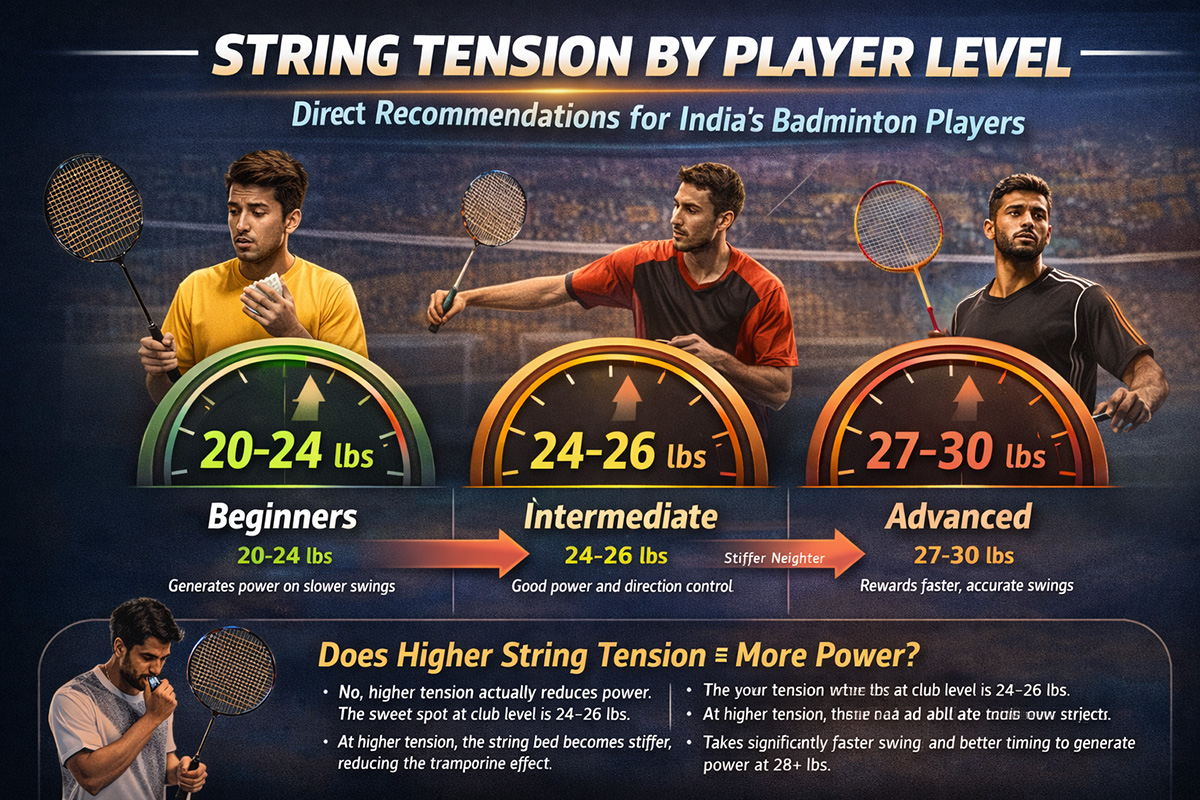
Beginners should string between 20 lbs and 24 lbs. At this range, the string bed has enough give to generate power even on slower, developing swings. The trampoline effect does the work — the string stretches at impact, helping push the shuttle back without requiring fast or precise technique.
Stringing higher than 24 lbs as a beginner is a common mistake. It makes the string bed stiffer, which requires faster swing speed and better timing to generate the same power. Without those, it falls short and lacks pace. Lower tension is genuinely more effective for beginners — not a compromise.
What string tension is best for intermediate and advanced players?
- Intermediate players (club level, 2–4 times per week): 24 lbs to 26 lbs. Good balance of power assistance and directional control. Most club players play their best badminton in this window.
- Advanced players (competitive, strong technique): 27 lbs to 30 lbs. Higher tension rewards fast, technically clean swings with more precise shot placement. Less forgiveness, more accuracy.
- Professional players: 30 lbs and above. At this level, the player generates all their own power through swing speed — the string is a precision tool, not a power aid.
Does higher string tension mean more power?
No — this is one of the most common misconceptions in badminton. Higher tension actually reduces power for most players.
Power from a string comes from the trampoline effect — the string stretching at impact and snapping back. Higher tension makes the string bed stiffer, reducing that stretch-and-snap action. To compensate, you need a significantly faster swing and better timing. Most club players who jump from 24 lbs to 30 lbs end up hitting weaker, not harder.
The sweet spot for smash power at club level is 24–26 lbs — enough tension for control, enough give for the string to assist the shot.
How do I know when it is time to increase my string tension?
Three clear signs you are ready to move up:
- Your smashes and clears are consistently going past the baseline — the string bed has too much give and is adding unwanted distance
- Your current string bed feels mushy or slow — shots lack crispness and do not respond precisely to your swing angle
- Your technique has improved noticeably — you are generating more swing speed consistently, not just occasionally
When you do increase, go up by 1–2 lbs at a time. Jumping from 24 lbs to 28 lbs in one step is hard on the arm and makes it difficult to know whether the new tension is actually working. Give each tension level 4–6 weeks of regular play before deciding to go higher.
What are the signs that my string tension is too high?
- Shoulder or elbow pain during or after play — the most serious sign. High tension transfers more shock to the arm on every shot. Do not ignore this.
- Clears falling short — swinging normally but the shuttle is not reaching the back court
- Shots feel harsh or board-like on impact — no give at contact, unpleasant vibration through the handle
- Increased string breakage — very high tension puts strings under constant stress even before play begins
If you are experiencing arm pain, drop tension immediately and consult a physio if it persists. Playing through arm pain on a high-tension racket will make the injury worse.
Tension by Playing Style and Environment
Beyond player level, how you play and what shuttlecock you use both affect the right tension choice. This section covers the practical scenarios most Indian club players face.
Which string tension gives the best smash power?
For most club players, 24 lbs to 26 lbs produces the strongest smashes. At this range the string provides enough trampoline effect to add pace without demanding professional-level swing speed to activate it.
If your technique is strong and your swing is fast, you can push to 27–28 lbs and maintain smash power while gaining more directional control. Above 28 lbs, smash power starts dropping for anyone not playing at a high competitive level.
Does higher tension improve net control and drop shots?
Yes, for players with sufficient swing speed and technique. A tighter string bed means the shuttle leaves the racket faster with less dwell time — giving more precise control over hairpins, net kills, and drop shots.
For club players still developing touch and feel at the net, higher tension can actually make net play harder. The reduced dwell time leaves less margin for timing and angle errors. Most club players find better net control comes from technique improvement rather than tension increases alone.
What string tension should I use for plastic or nylon shuttlecocks?
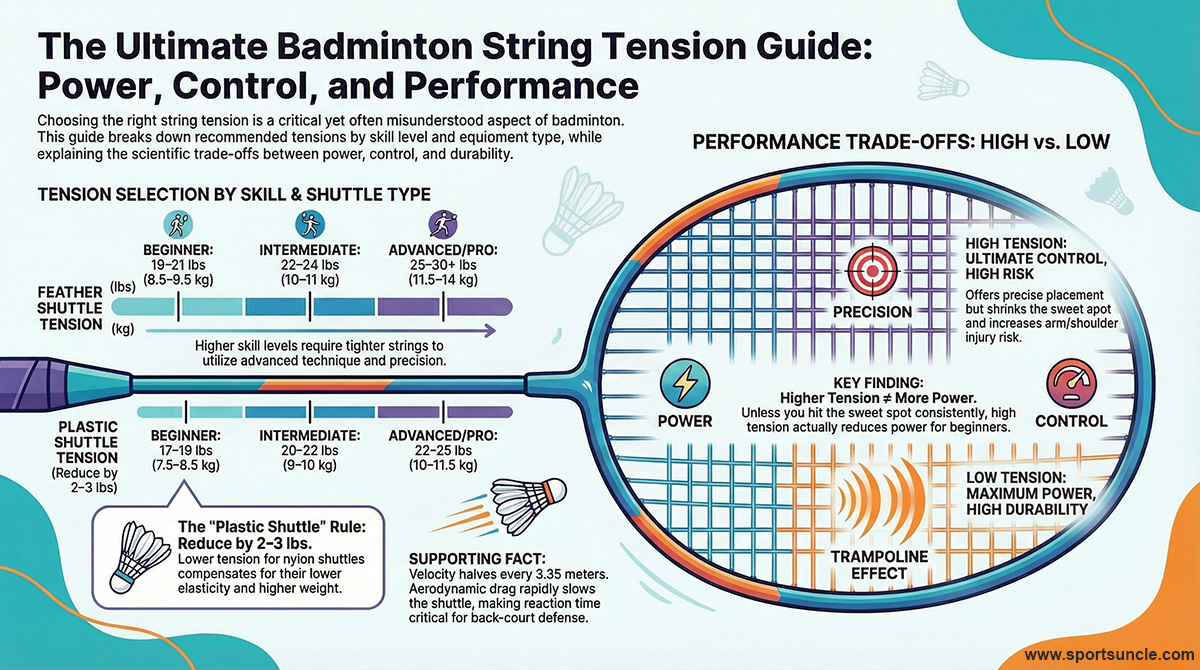
Drop your tension by 2 to 3 lbs when playing primarily with plastic shuttlecocks.
Plastic shuttles are heavier than feather and fly differently — they require more force to travel the same distance. At the same tension you use for a feather, plastic shuttles hit harder against the string bed, increasing the breakage rate significantly. Lower tension absorbs that extra impact better and extends string life.
If you normally string at 26 lbs for feather shuttles, try 23–24 lbs for plastic. Flight depth improves and strings last noticeably longer. This is especially relevant for Indian club players who use plastic shuttles for most sessions.
Is it safe to string above the manufacturer's recommended maximum tension?
No. Stringing above the manufacturer's maximum puts stress on the racket frame that it was not designed to handle. The most common outcome is a stress fracture in the frame, which can happen immediately during stringing or during play without warning.
The manufacturer's maximum tension is the ceiling — not a conservative suggestion. Exceeding it voids the warranty and significantly increases the risk of frame damage. No performance benefit at the club level justifies that risk. If you are a professional player, then go for it; who is stopping you?
What is the best string for players with shoulder or elbow pain?
Two things reduce arm stress from stringing:
- Lower tension: Drop to 22–24 lbs if you are experiencing arm pain. The softer string bed absorbs more impact at contact rather than transmitting it through the handle to your arm.
- Thicker or multifilament strings: Thicker strings (0.68mm–0.70mm) and multifilament constructions like Woods Metaflex are more arm-friendly than thin monofilament strings. They have more give at contact, reducing the shock spike on every shot.
If you are playing with a stiff shaft racket at high tension and experiencing arm pain, change both. Drop tension first, then consider a medium-flex shaft racket if the pain persists. Do not play through persistent arm pain and attribute it only to technique.
String Selection and Performance
Once you understand gauge and tension, the next step is choosing the right string for your playing style. This section covers what each type of string actually does in practice.
Which badminton string gives the loudest smash sound?
The loudest, most crisp smash sound comes from thin, high-repulsion strings. The acoustic response is a byproduct of the fast snap-back at impact — thinner strings produce a sharper, higher-pitched sound.
Yonex Aerosonic (0.61mm) and Yonex Exbolt 63 (0.63mm) produce the most pronounced sound from our range. Yonex BG66 is also well known for its sharp acoustic response. Thicker strings like BG65 produce a noticeably duller sound, which reflects the difference in repulsion speed between gauge types.
Which string lasts the longest for regular players?
Yonex BG65 is the most durable option at 0.70mm. It is the standard choice for daily training, heavy hitters, and players who cannot restring frequently. It takes significant punishment before snapping and maintains playable tension longer than thinner strings.
If you want more repulsion than BG65 while keeping durability above average, Yonex Exbolt 68 (0.68mm) is the right step up. Forged Fiber construction gives it better longevity than standard strings of the same gauge.
Can you get both durability and power from a single string?
Yes — several strings in our range hit this balance well:
- Yonex BG80 Power: 0.68mm, hard and stiff. Strong repulsion for smashers with better durability than thinner power strings. Good for club players who want to smash hard without changing strings every few weeks.
- Yonex Exbolt 65: 0.65mm with Forged Fiber. Better durability than standard strings at this gauge — repulsion closer to a thin string with lifespan closer to a thicker one.
- Yonex Exbolt 68: 0.68mm Forged Fiber. Most durable of the Exbolt range while still offering noticeably better repulsion than BG65.
Will thinner strings improve shuttle control?
Thinner strings improve placement precision - the faster repulsion responds more directly to your swing angle, giving advanced players more precise shot placement on smashes and clears.
However, for spin control and shuttle grip on net shots, slices, and hairpins, string coating and texture matter more than gauge. Strings with rougher or textured surfaces bite the shuttle at contact for more feel and spin on delicate shots. Yonex Aerobite Boost uses this principle — its cross strings are specifically textured for shuttle grip rather than pure repulsion.
The answer depends on what type of control you mean - placement precision or touch and feel at the net. They are different things controlled by different string characteristics.
What is a hybrid badminton string setup?
A hybrid setup uses two different strings - one for the main strings (vertical) and another for the cross strings (horizontal). The goal is to combine strengths that individual strings trade off against each other.
Yonex Aerobite Boost is a factory-designed hybrid - the main string is 0.72mm for durability and frame stability, while the cross string is 0.61mm for repulsion and shuttle grip. The result handles hard smashes durably, while the thin cross strings provide spin and control on net play.
Custom hybrid setups are also done by experienced stringers - pairing a durable main with a thin repulsion cross is the most common combination. Not all stringers in India offer this, so confirm before requesting it.
Brand and Model Specifics
This section covers the specific strings available with honest assessments of who each one suits best.
What is the difference between Yonex BG65 and BG80 Power?
- BG65 (0.70mm): Soft feel, maximum durability, gentle on the arm. The most popular training string in India at the club level. Suits beginners and recreational players who prioritise string life over repulsion.
- BG80 Power (0.68mm): Hard, stiff feel with significantly more repulsion than BG65. Designed for aggressive smashers who want power from the string. Loses tension faster than BG65 and needs restringing more frequently to stay at peak performance.
Choosing between the two: BG65 if you play 2–3 times a week and want consistent, low-maintenance performance. BG80 Power if you play regularly, hit hard, and are willing to restring more often for better smash response.
What is the difference between BG65 and BG65 Ti?
BG65 Ti is the titanium-coated version of BG65. The coating adds two things:
- Slightly more repulsion — the titanium coating stiffens the string surface marginally, giving a crisper feel and fractionally more snap-back than standard BG65
- Better tension retention — the coating helps the string hold its tension slightly longer
Durability is comparable to standard BG65 — both are 0.70mm. BG65 Ti is a sensible upgrade for a player who has been on BG65 and wants a modest improvement in feel without jumping to a thinner, more demanding string. The price difference is small, and the feel improvement is real but subtle.
Which Yonex string is best for a beginner?
Yonex BG65 is the right starting point for most beginners. It is durable enough to withstand the mishits that occur while technique is still developing, soft enough to be arm-friendly at lower tensions, and consistent enough to provide reliable feedback as you improve.
BG65 Ti is a reasonable alternative if you want a small step up in feel — same durability with slightly more crispness.
Avoid Exbolt 63, Aerosonic, and other thin strings as a beginner. They snap quickly from off-centre strikes, which are more frequent as the technique develops. The restringing cost adds up fast, and the performance benefit requires a level of consistency you have not yet built.
How does the Yonex Exbolt series differ from the BG series?
The Exbolt series uses a material called Forged Fiber — a proprietary construction that allows thinner gauges without the usual durability penalty of going thin. Standard thin strings are fragile — the fine construction that gives repulsion also makes them snap quickly. Forged Fiber changes how the string is manufactured to address this.
- Exbolt 63 (0.63mm): Maximum repulsion. Suited for advanced players with consistent technique and fast swing speed.
- Exbolt 65 (0.65mm): Strong repulsion with better durability than Exbolt 63. The most balanced option for intermediate-advanced players.
- Exbolt 68 (0.68mm): The durability-focused Exbolt. Better repulsion than BG65 but built for players who want Exbolt performance without frequent restringing.
What is Yonex Aerobite Boost best used for?
Aerobite Boost is a hybrid string — factory-paired mains and crosses with different gauges. The thick main (0.72mm) provides frame stability and durability for hard smashes. The thin cross string (0.61mm) grips the shuttle at contact, producing more spin and control on net shots, cross-net drops, and cut smashes.
It suits players who play an attacking net game — spinning hairpins, cross-net deception, and sliced drops. It is less suited to pure baseline power players who want maximum repulsion smash performance - for those players, Exbolt 63 or BG66 is a better fit.
What is the Yonex BG66 best used for?
Yonex BG66 is a 0.66mm string with a sharp, high-repulsion feel and a crisp acoustic response. It sits between the durability-focused BG65 and the ultra-thin Exbolt range - more repulsion than BG65 with better durability than the thinnest Exbolts.
It suits intermediate to advanced players who want a noticeable repulsion improvement over BG65 without fully committing to the fragility of sub-0.65mm strings. Good for smash-focused players who play 3–4 times per week and restring every couple of months.
Who should use Yonex Nanogy 95?
Nanogy 95 is a 0.69mm string with a sharp, high-pitched feel that delivers more repulsion than its gauge suggests. It is built around quick response and a lively feel in fast exchanges.
It suits intermediate to advanced players who play fast doubles or mixed doubles — the repulsion works well for drives, flicks, and quick net exchanges. Also, a good option for players who want more feel than BG65 offers but find thinner Exbolt strings too fragile for their hitting pattern. Tension sweet spot: 24–27 lbs.
What is Woods Metaflex string — who is it for?
Woods Metaflex is a multifilament string — constructed from multiple fine fibers twisted together rather than a single solid strand. This gives it a softer, more cushioned feel at contact compared to monofilament strings like BG65 or the Exbolt range.
It suits two player types:
- Players with arm or shoulder sensitivity — multifilament construction absorbs more impact shock than monofilament, reducing stress on the arm on every shot
- Players who prioritise feel and touch over maximum repulsion — the softer construction gives more feedback on net shots and drops
It is not the right choice for players who prioritise smash power or string durability above all else — for those, BG65 or BG80 Power is a better fit.
What tension should I use for Yonex Astrox rackets?
Astrox rackets are head-heavy, power-oriented frames. Manufacturer-recommended tension is typically 19–28 lbs, depending on the specific model.
- Beginners on Astrox entry models Astrox 99 Play: 22–24 lbs — the head-heavy balance already generates momentum, so lower tension still produces strong smashes
- Intermediate club players on Astrox 100 tour: 24–26 lbs — the standard sweet spot for controlled power
- Advanced players on Astrox 99 Pro or higher: 26–28 lbs — take advantage of the frame's power profile with a stiffer string bed for precision.
Always check the specific model's throat area for the manufacturer's stated maximum tension and do not exceed it.
What tension should I use for Yonex Nanoflare rackets?
Nanoflare rackets are head-light, speed-oriented frames designed for fast exchanges and doubles play. Recommended tension is typically 19–28 lbs, depending on the model.
- Beginners and club players on Nanoflare entry models: 22–24 lbs — head-light balance means the racket generates less natural momentum, so lower tension helps with clears and smashes
- Intermediate players: 24–26 lbs — balanced for fast doubles play
- Advanced players on Nanoflare 1000 Z: 25–28 lbs — tighter string bed complements the frame's precision profile for drives and net play
Which string is best for maximum smash power in India?
- Yonex BG80 Power: Hard, stiff repulsion specifically designed for smashers. Best at 24–27 lbs for club players — the strongest smash option with above-average durability.
- Yonex BG66: High repulsion with a sharp response. Good smash performance with slightly better durability than ultra-thin strings.
- Yonex Exbolt 63: Maximum repulsion in the Exbolt range. For advanced players with fast swing speed who restring regularly.
For most Indian club players, BG80 Power at 25–26 lbs gives the best smash performance without the fragility of thinner strings.
Restringing and Maintenance
Strings lose tension and elasticity over time, even without breaking. This section covers when to restring, what causes early breakage, and how to store rackets correctly.
Why do my strings break so quickly, especially near the frame?
Breaking near the frame is almost always caused by mishits — striking the shuttle outside the sweet spot. Strings at the frame edges have very little room to stretch on impact. When force hits them, they take the full stress without the give that centre strings have.
Other causes of faster-than-expected breakage:
- Tension too high for the string gauge: Thin strings at high tension are under constant stress before play begins
- Playing with plastic shuttles at feather tension: Plastic shuttles are heavier and hit harder against the string bed
- Storing the racket in heat: Leaving a racket in a hot car or direct sunlight degrades the string material and makes it brittle
- Frame clashes in doubles: Direct racket-to-racket contact at the frame edge will snap strings regardless of gauge
Where can I get my racket restrung?
At SportsUncle, we offer professional restringing with all new racket purchases — the racket leaves properly strung at your specified tension on a calibrated machine.
For standalone restringing, find a certified stringer in your city. Look specifically for stringers using electronic or computerised machines — hand-cranked machines produce inconsistent tension across the string bed. Ask what machine they use and whether they calibrate it regularly. A proper restring on a calibrated machine makes a measurable difference to how the racket performs.
How often should club players restring their rackets?
A practical rule: restring as many times per year as you play per week. Playing 3 times a week means restringing at least 3 times a year — roughly every 4 months.
This matters even when the strings have not broken. Strings lose elasticity and tension from repeated impact and exposure to humidity and temperature changes. A string that has been playing for 6 months at 26 lbs may only be performing at 21–22 lbs by that point - significantly affecting power and control without an obvious visual sign.
If your shots feel inconsistent or clears are falling shorter than usual despite normal swing effort, tension loss is often the cause — not technique.
Can I repair a single broken string, or do I need a full restring?
Full restring — always. There is no effective way to splice or repair a single broken string. A repaired area will be at a different tension than every other string on the racket, causing inconsistent shot response and asymmetric stress on the frame.
Over time, uneven tension can warp or crack the racket head. The cost of a full restring is significantly less than replacing a damaged frame.
How do temperature and humidity affect badminton strings?
- High heat causes strings to expand and lose tension. A racket left in a hot car for several hours can lose 2–3 lbs of tension without any play. Repeated exposure degrades the string material, making it brittle.
- Extreme cold makes strings less elastic — increasing the chance of snapping on the first hard shot.
- High humidity (common in India during monsoon) accelerates tension loss and can make synthetic strings feel softer and less responsive over time.
Store rackets in a thermal bag away from direct sunlight and not in car boots. This is the single easiest way to extend string life between restrings.
What does restringing cost in India?
- Labour charge only: ₹100–₹200 at most local sports shops
- Labour + mid-range string (BG65, BG65 Ti): ₹500–₹650 total depending on city
- Labour + premium string (Exbolt range, BG80 Power): ₹650–₹1200 total
The string itself is often the bigger cost variable. Buying your own string from a verified source and paying for labour-only restringing are common approaches for players who restring frequently. Always ask what machine the stringer uses — cheap hand-cranked machines produce inconsistent tension and are not worth the savings.
Can I restring my racket at home?
Technically, yes — home stringing machines exist. But for most Indian club players, it is not worth it.
A decent home hand machine (not electronic) costs ₹15,000–₹25,000 and requires significant practice to produce consistent tension across the entire string bed. An inconsistent home restring can feel worse than an old string job and puts uneven stress on the frame.
Unless you are restringing 4 or more rackets per month consistently, the economics do not work. Find a certified stringer in your city with a calibrated electronic machine. The quality difference between a good stringer and a poor one is larger than most players realise.
Budget and Buying in India
String prices in India vary across a wide range. Here is what to expect and what to buy at each price point.
What is the best badminton string under ₹500 in India?
Yonex BG65 is the strongest option in this range — durable, consistent, and suitable for beginners through intermediate players. At under ₹500 it remains one of the most used club strings globally for good reason.
Li-Ning strings and Woods Metaflex also fall in this budget range. Li-Ning offers solid mid-range performance as a Yonex alternative. Metaflex suits players who want a softer, arm-friendly feel at the same price point.
What is the best badminton string under ₹700 in India?
At under ₹700, your options expand meaningfully:
- Yonex BG65 Ti: Small upgrade over BG65 — same durability, slightly more repulsion and tension retention from the titanium coating
- Yonex BG66: Noticeable repulsion improvement over BG65, suits intermediate players wanting more from their string
- Yonex BG80 Power: Top smash-performance option in this range — hard, stiff feel for aggressive hitters
- Yonex Nanogy 95: Fast repulsion and sharp feel, well-suited to doubles players and fast-paced play
For most club players upgrading from BG65, BG80 Power or BG66 is the most impactful step up at this price range.
What is the best badminton string above ₹800 in India?
Above ₹800 you are in the premium string range — Exbolt series, Aerosonic, and Aerobite Boost:
- Yonex Exbolt 68: Best entry point into the Exbolt range. Forged Fiber, good repulsion, better durability than thinner Exbolts. For intermediate to advanced players.
- Yonex Exbolt 65: Stronger repulsion than Exbolt 68 with the same Forged Fiber durability advantage. For advanced club players with consistent technique.
- Yonex Exbolt 63: Maximum repulsion in the range. For advanced players with fast swing speed who restring regularly.
- Yonex Aerosonic: Ultra-thin at 0.61mm. The most repulsion available — for high-level competitive players only.
- Yonex Aerobite Boost: For net-focused players who want spin control and shuttle grip alongside smash durability.

Vijaydeep Saini
Smashing sentences and shuttlecocks with equal precision. A wordsmith on the court and an athlete at the keyboard, serving aces and anecdotes. Pen in hand, racket ready—let’s play.
Leave a Reply
Your email address cannot be published. Required fields are marked*
Latest Articles from Blog
No comments